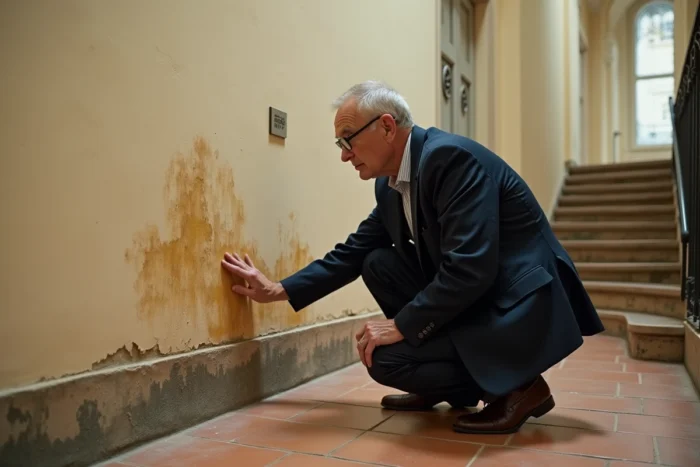
The distribution of the costs for treating moisture in co-owned walls is based on a determining criterion: the technical origin of the disorder. A degraded wall in a private lot may fall under the responsibility of the co-ownership association or the occupying co-owner, depending on whether the expert concludes a defect in the structural work or a condensation problem related to the use of the dwelling.
Technical qualification of the disorder: the pivot of cost distribution
Co-ownership practice and insurers now apply a tripartite reading grid. Three categories of origin determine who bears the cost of the work.
- Defect in structural work or common areas: rising damp, facade porosity, roof waterproofing defect, leak on the rising column. The co-ownership association finances the work, distributed according to the shares.
- Defect in routine maintenance attributable to the occupant: blocked ventilation grilles, unmaintained mechanical ventilation, lack of regular aeration, insufficient heating generating condensation. The co-owner (or the tenant according to the lease) bears the cost.
- Mixed origin: infiltration through a load-bearing wall aggravated by a lack of ventilation in the private lot. The costs are then shared, often after contradictory expertise.
We observe that the majority of disputes arise from the second category. A wall covered with mold in an apartment often leads the property manager to attribute responsibility to the private lot, while the problem may stem from an undetected crack in the facade.
The issue of moisture treatment in co-ownership is therefore played out well in advance, starting from the diagnostic phase, and not at the time of voting in the general assembly.
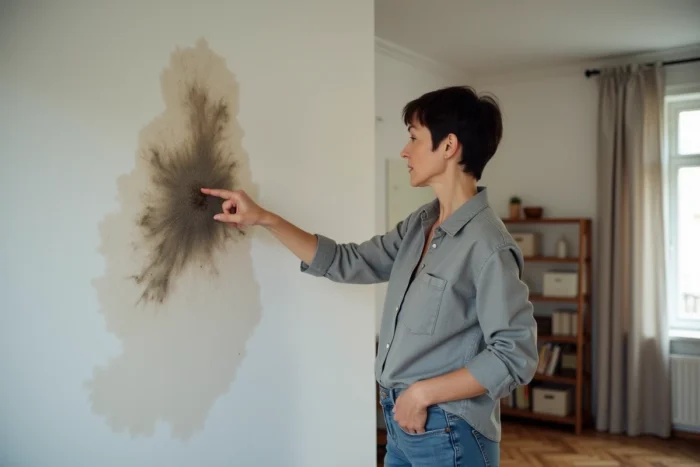
Role of expertise in the management of moisture work
Without an expert report, no property manager can validly charge the costs to either party. We systematically recommend a contradictory expertise rather than a simple visual assessment by the caretaker or a craftsman.
Expertise commissioned by the property manager or by the co-owner
When the property manager commissions an expert, the diagnostic costs are charged to the current budget of the co-ownership. If the expertise concludes a defect in structural work, the costs are classified as common charges. If it concludes a defect in usage, the property manager directs the co-owner to their own insurance.
A co-owner can also commission their own expert. This report does not have binding value for the association but can serve as leverage in the general assembly or before the judicial court in case of a deadlock.
Distinction between leak detection and structural moisture diagnosis
The IRSI agreement regulates leak detection in the context of a classic water damage incident. Structural moisture (rising damp, chronic condensation) does not fall under this agreement. Insurers often exclude the effects of condensation or ambient moisture from their guarantees. A co-owner who declares a “water damage” claim for a mold problem related to condensation will likely face a denial of coverage.
Responsibility of the association and voting in the general assembly for load-bearing walls
Load-bearing walls are common areas by nature, unless otherwise stipulated in the co-ownership regulations. Any degradation of a load-bearing wall due to moisture engages the responsibility of the co-ownership association, even if the damage manifests only in a private lot.
The vote for treatment work (resin injection, peripheral drainage, waterproofing restoration) requires the majority under article 24 of the law of July 10, 1965 for routine maintenance, or the majority under article 25 for improvement work. In practice, treatment against rising damp on foundations almost always falls under article 24.
The aggrieved co-owner who does not obtain the vote in the assembly can take the judicial court to compel the association to carry out the work. The property manager engages their responsibility if they do not put the issue on the agenda despite a written request accompanied by an expert report.
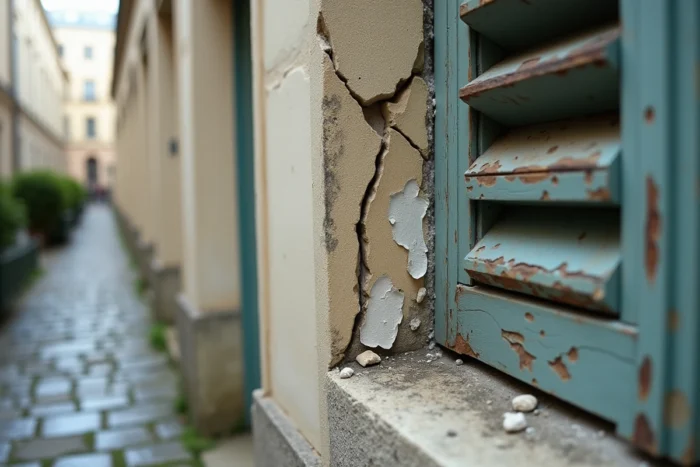
Tenant or owner: who pays what within the private lot
When moisture arises from a lack of maintenance or usage inside the dwelling, the distribution between the landlord and tenant follows the logic of the decree of August 26, 1987 concerning rental repairs.
The tenant is responsible for cleaning the ventilation grilles, maintaining the individual mechanical ventilation, and regularly airing the dwelling. The owner remains responsible for replacing a faulty mechanical ventilation system or for bringing the ventilation system into compliance.
In the case of mold caused by a structural ventilation defect (absence of mechanical ventilation in an old dwelling, for example), the owner cannot pass the costs onto the tenant. The law requires the landlord to provide decent housing, which includes sufficient ventilation.
Recourse between co-owner and association
A property owner who has financed treatment work in their private lot can take action for reimbursement against the association if subsequent expertise demonstrates that the origin of the disorder lies in the common areas. The limitation period is ten years for contractual liability between the association and its members.
The interplay of insurances (co-ownership insurance, non-occupying owner insurance, tenant’s home insurance) often complicates the settlement. Each insurance tends to pass the responsibility onto the other, which justifies always requiring an expert report clearly identifying the origin before undertaking any work.
The reflex to adopt in the face of a damp wall in co-ownership remains the same: technically qualify the disorder before any discussion on financial responsibility. Without this step, neither the property manager, nor the insurer, nor the court can determine the distribution of costs.