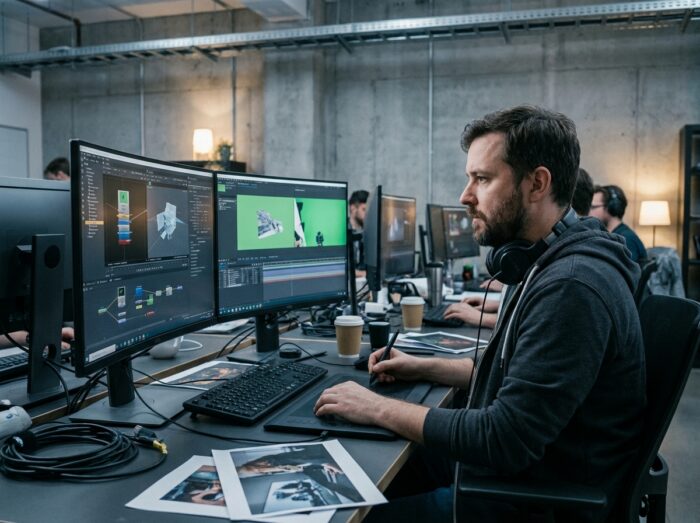
A studio that delivers VFX plans accepted on the first review by a production-side supervisor saves time, margin, and secures recurring contracts. The gap between teams that succeed and those that accumulate retakes rarely comes down to raw artistic talent. It revolves around three axes: the technical compliance of the pipeline, the integration of real-time tools and AI, and the ability to operate on distributed workflows.
VFX Pipeline Compliance with Delivery Specifications
The technical specifications of studios and platforms are no longer limited to resolution and codec. Each project now imposes a set of standards on the color space (ACES, often in ACEScg for rendering), the naming of multi-layer EXR files, the expected AOV passes, and the format of embedded metadata.
An artist or studio delivering a final composite without adhering to the requested AOV hierarchy (diffuse, specular, reflection, cryptomatte) forces the client to request rework or recomposition. This type of friction, invisible in a portfolio, is the primary criterion for elimination on recurring projects.
We recommend locking the scene template from the kickoff: Nuke or Fusion configuration aligned with the project’s color pipeline, automatic validation scripts for pass names, and test exports sent before the first real shot. A validated template in advance eliminates the majority of technical retakes.
To prepare for studio requests in VFX, understanding these delivery requirements is a prerequisite that many profiles underestimate in favor of mere software proficiency.
Virtual Production and Real-Time Engines in the VFX Pipeline
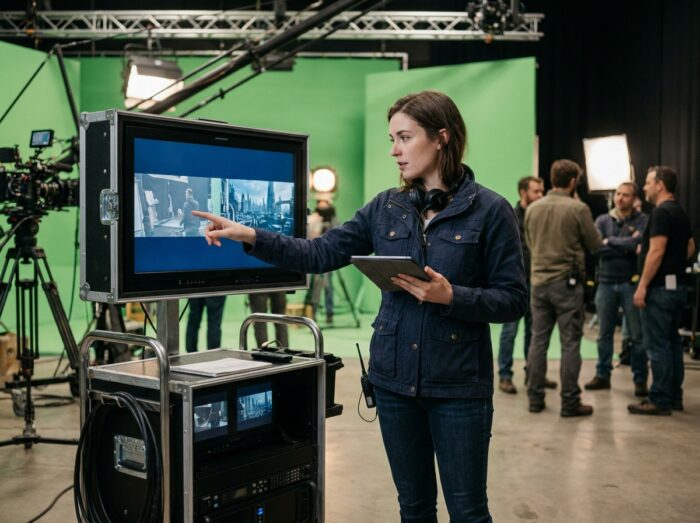
Virtual production is no longer a technological demonstrator reserved for blockbusters. LED volumes, pre-visualization in Unreal Engine, and real-time performance capture are being integrated into mid-budget series productions. Real-time now comes into play from the planning stage of the shoot, not just in post-production.
For a VFX artist, this changes the nature of the work. Pre-visualization (previz) and techviz become full-fledged deliverables, expected before the first day of shooting.
A VFX supervisor on a LED volume shoot must validate lighting, the parallax of virtual sets, and the consistency of reflections on costumes in real-time. Delivering a functional Unreal Engine environment for a set requires skills in real-time lighting, LOD management, and framerate optimization, well beyond the classic curriculum of compositing or Houdini FX.
Technical Skills to Develop for Virtual Production
- Mastery of Unreal Engine (or Unity) for creating real-time environments usable on an LED volume, with management of camera frustum and screen-sensor color mapping
- Knowledge of camera tracking systems (Stype, Mo-Sys) and their integration into the engine to ensure synchronization between virtual set and physical movement
- Ability to work in tandem with the director of photography to adjust virtual lighting based on shooting choices, which requires a solid photographic culture
VFX Voice emphasizes that virtual production is now treated as a sustainable evolution of the profession, not as a marginal trend. Studios hiring are looking for hybrid profiles capable of transitioning from the classic offline pipeline to a real-time environment without workflow disruption.
Integration of AI in the VFX Chain: Beyond the Buzzword
AI now comes into play well before final post-production. Assisted storyboarding, generative concept art, automated animatics, neural upscaling: tools are multiplying, and studios are beginning to formalize their place in the pipeline.
The question is no longer whether a VFX artist will use AI, but how well they can frame it. Mediakwest reports that future projects could integrate specialized AI providers alongside VFX supervisors. This means that the ability to pilot an AI tool becomes a supervisory skill, not just an execution one.
In practice, we observe three levels of adoption in studios:
- Level 1: occasional use of neural denoising, upscaling, or automated rotoscoping tools (like Runway, Topaz) to accelerate repetitive tasks
- Level 2: integration of generative models in the concept and previz phase, with systematic human validation before moving into production
- Level 3: hybrid pipeline where AI generates intermediate passes (depth estimation, relighting) that feed into the final composite under artistic control
Level 3 remains rare in France, but it is the direction in which the expectations of international platforms are converging. An artist who masters prompting, ControlNet or IP-Adapter control, and can identify typical artifacts of neural generation brings measurable value. High-frequency texture inconsistencies and anatomical drift across multiple frames are the warning signals to prioritize.
Cloud Workflows and Distributed Pipelines for VFX Projects
Working remotely on a VFX project is not just about VPN access and shared storage. Studios expect mastery of collaborative and distributed pipelines: asset management via ShotGrid (formerly Shotgun), scene synchronization via Perforce or proprietary solutions, cloud rendering on elastic farms (AWS Thinkbox Deadline, Google Cloud Batch).
The main constraint is bandwidth and latency on large files. A 4K multi-layer EXR shot weighs several hundred megabytes per frame. Artists who know how to work with smart proxies, validate on lighter versions, and then launch the final render on a remote farm can integrate into international productions without logistical friction.
Data Security and Compliance
Studios impose strict protocols: encryption of transfers, automatic watermarking, access restrictions by shot and department. A freelance artist who does not comply with these protocols is removed from the project. MPAA (Motion Picture Association) compliance for content security has become a standard that every provider must know, including small structures.
The shift to the cloud also redistributes the rendering load. Rather than investing in expensive local hardware, a studio can scale its computing capacity to the project. But this requires knowing how to estimate a cloud budget, configure suitable GPU instances, and monitor consumption in real-time to avoid overruns.
Studio expectations in VFX converge towards a profile of artist-technician capable of navigating between artistic creation, pipeline rigor, and technological agility. Mastery of a compositing or simulation software is no longer sufficient. What makes the difference is the ability to deliver a compliant shot on the first try, to operate in a real-time environment on set, and to integrate AI as a controlled production tool.