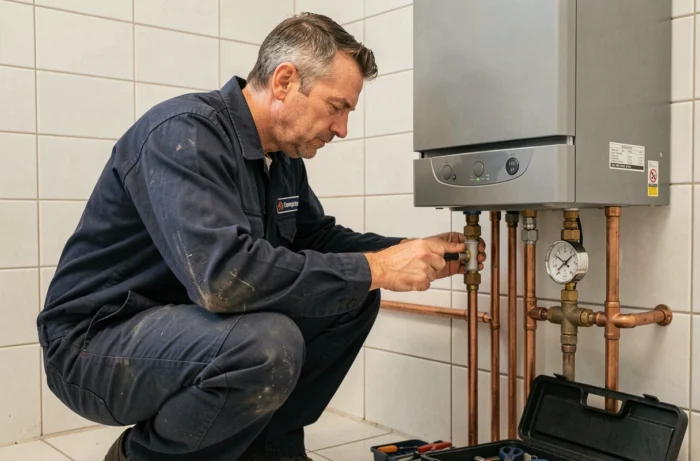
Your radiator remains lukewarm, hot water takes several minutes to arrive, or an error code is flashing on the boiler’s screen. Before urgently searching for a heating technician’s number, one question deserves to be asked: do you need a repair, routine maintenance, or a regulatory check? In Brussels, the answer changes the bill, the type of technician required, and even who should pay.
Repair, maintenance, or energy performance check: three interventions that Brussels distinguishes
Many homeowners and tenants confuse these three services. However, they do not share the same legal framework, objective, or cost.
The boiler repair is a corrective intervention. A technician identifies the breakdown (faulty valve, short-circuited probe, pressure defect) and puts the device back into service. No specific certification is required for this type of one-off repair, although an experienced heating technician is preferable.
Routine maintenance, on the other hand, is preventive. In Brussels, it is mandatory every two years for a gas boiler and annually for an oil boiler. It includes cleaning the burner, checking combustion, and verifying safety devices.
The energy performance check (PEB) goes further. It assesses the overall efficiency of the heating installation and issues an official certificate. This check can only be carried out by a technician accredited by the Brussels-Capital Region. An unaccredited heating technician can certainly repair your boiler, but their visit does not replace a valid PEB check.
The practical consequence is direct: if you call a regular repair technician when your actual need is a regulatory check, you risk paying for two separate interventions. Before picking up the phone, it is worth calling for a boiler repair in Brussels while first checking which type of service corresponds to your situation.

Signs of boiler failure: when repair cannot wait
Some symptoms justify an immediate call. Ignoring them means allowing a mechanical problem to turn into a costly repair, or even a safety risk.
- The boiler repeatedly goes into safety mode and displays an error code after each restart. This often indicates a flame fault, a gas evacuation problem, or a malfunctioning sensor.
- An unusual smell (gas, incomplete combustion) is coming from the device or the ventilation. In this case, turn off the gas supply and ventilate before taking any other action.
- The circuit pressure regularly drops below the minimum threshold indicated by the manufacturer, despite water replenishment. This may reveal an internal leak or a faulty expansion vessel.
- Hot water is produced intermittently or not at all, while heating works normally. The problem often lies with the three-way valve or the plate heat exchanger.
Outside of these situations, a slight circulation noise or a slow temperature rise does not necessarily constitute an emergency. A scheduled maintenance is then sufficient to restore normal operation.
Who pays for the repair in Brussels: tenant or owner
You have detected the fault and identified the correct type of intervention. The financial question remains, a frequent source of disputes between landlords and tenants.
The principle in the Brussels Region is as follows: routine maintenance is the tenant’s responsibility, unless otherwise stated in the lease. Cleaning the burner, replacing small wear parts, and periodic visits fall under the normal use of the accommodation.
The replacement of a major component (heat exchanger, electronic board, heat body) is the owner’s responsibility. These repairs do not result from a lack of maintenance but from the aging of the installation.
The mandatory PEB check remains, however, the legal responsibility of the owner, even when the lease stipulates that the tenant manages maintenance. The owner must ensure that the check is carried out on time and by an accredited technician. If they fail to do so, it is they who face administrative penalties, not the tenant.
The trap of the unaccredited technician
Imagine a tenant who calls a heating technician for a pressure problem. The technician repairs the leak, bills for their intervention, but does not issue any PEB certificate. A few weeks later, the owner discovers that the periodic check has not been carried out. They then have to bring in an accredited technician, at their own expense, for a second visit.
This scenario is common because the distinction between repair and regulatory check is not obvious to a non-specialist. Systematically asking your heating technician if they have regional accreditation avoids this kind of duplication.
Gas or oil boiler in Brussels: different repair constraints
The type of fuel directly influences the frequency of maintenance, the availability of parts, and the cost of repairs.
Gas boilers, which are very common in Brussels, benefit from a dense network of technicians and easily accessible spare parts for common brands (Vaillant, Bulex, Viessmann, Buderus). The mandatory maintenance every two years allows for a reasonable margin.
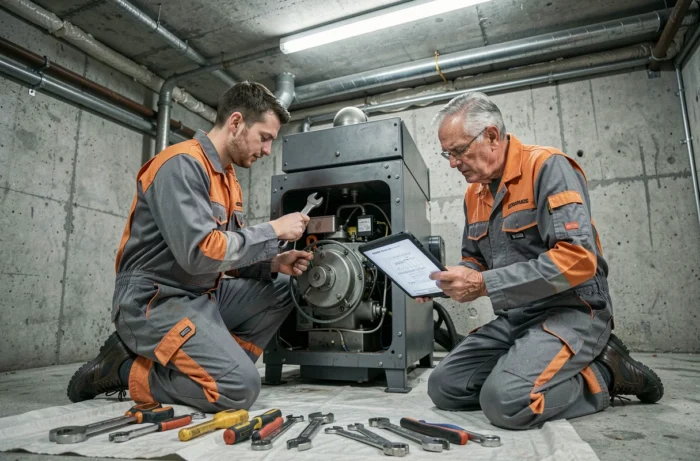
Oil boilers, on the other hand, require annual maintenance. They are also affected by the gradual ban on oil in new installations in Brussels. Repairing an aging oil boiler can therefore pose a dilemma: invest in an expensive part for a device whose fuel will eventually be banned, or anticipate replacement.
Condensing boilers, whether they run on gas or oil, add a layer of complexity. Their high efficiency relies on sensitive components (condensate siphon, stainless steel heat exchanger). Poor adjustment or neglected descaling quickly reduces their effectiveness. The technician must master the specifics of condensation, not just the general mechanics of heating.
Plan rather than suffer: the right intervention schedule
The majority of boiler failures occur at the time of restart, after several months of inactivity. Scheduling maintenance at the end of summer or the beginning of autumn allows for the detection of problems before the first cold spells, when heating technicians are still available without delay.
This simple schedule reduces the risk of finding yourself without heating in the middle of winter and accepting, in an emergency, the first available intervention without checking the technician’s accreditation or the exact scope of the service.
A well-managed boiler repair in Brussels always starts with the same step: precisely identifying what you need before contacting anyone. This distinction between repair, maintenance, and PEB check determines the technician to call, the budget to prepare, and who will settle the bill.