
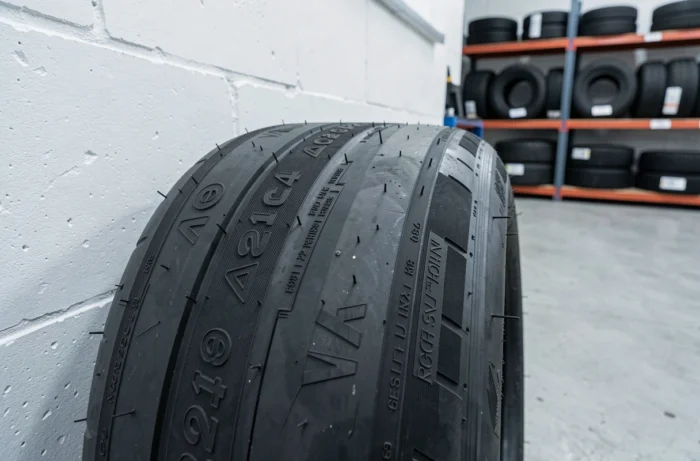
A marking on the sidewall of a tire may seem trivial, but the difference between 91V and 94V represents a measurable gap in load capacity. This article compares the two indices to determine which one truly corresponds to your usage, relying on load data and regulatory constraints.
Load index 91V vs 94V: compared data
The load index is the number that precedes the letter on the tire’s sidewall. The letter V, common to both versions, indicates a maximum certified speed of 240 km/h. The difference lies solely in the permissible load per tire.
| Index | Max load per tire | Total load (4 tires) | Max certified speed |
|---|---|---|---|
| 91V | 615 kg | 2,460 kg | 240 km/h |
| 94V | 670 kg | 2,680 kg | 240 km/h |
| Difference | +55 kg | +220 kg | Identical |
The difference of 55 kg per tire, or 220 kg on four wheels, is not trivial. It is equivalent to three adult passengers or a loaded trunk for a long trip.
To understand in detail the difference between tire 91V and 94V, one must also consider the tire’s structure: a 94 index implies a reinforcement of the casing that alters the rolling behavior.
Actual vehicle load: the criterion imposed by the registration document
The choice between 91V and 94V is not a matter of personal preference. The registration document (field F.1 for maximum load mass, G.1 for unladen weight) sets the constraints. A tire with a load index lower than that recommended by the manufacturer is non-compliant with the technical inspection.
Regulatory rule on load index
Fitting a higher load index than the manufacturer’s recommendation is allowed. Fitting a lower index is not. If your registration document or the vehicle manual indicates 94V, you cannot go down to 91V without risking a refusal at the technical inspection and, above all, compromising safety.
On the other hand, if the manufacturer recommends 91V, switching to 94V remains legal and can be justified in certain specific usage cases.
Tire 91V or 94V for station wagons, SUVs, and electric vehicles
The increase in mass of the vehicle fleet in recent years makes this question more frequent. Compact SUVs, family station wagons, and electric vehicles have significantly higher unladen weights than older generation compact sedans.
- A compact electric vehicle often weighs several hundred kilograms more than its thermal equivalent, due to the battery. The 94V offers a safety margin suitable for this structural overweight.
- A station wagon or minivan loaded for a vacation trip (passengers, luggage, roof rack) can approach the maximum authorized load mass. The switch from 91 to 94 absorbs this overload.
- A 7-seater SUV commonly uses load indices from 96 to 104. A lighter 5-seater model can operate on 94V, but rarely on 91V if the manufacturer has not planned for it.
For a city car primarily used solo or in pairs, a 91V tire is sufficient if validated by the manufacturer. The 94V would be oversized without real benefit.
Impact on comfort and consumption
A tire with a higher load index has a reinforced casing, thus more rigid. This increased rigidity results in slightly less supple filtering of road irregularities.
Ride comfort may noticeably decrease on degraded roads, especially with low profiles. On the highway, the difference is minimal.
Regarding fuel consumption, the rolling resistance of a reinforced tire is marginally higher. The gap remains difficult to isolate in daily use, but it exists.

Check the manufacturer’s recommendation before any tire purchase
The process is simple but too often overlooked. Three reliable sources can confirm the required index:
- The label affixed to the driver’s door frame, which indicates the complete dimension along with the load index and speed letter.
- The maintenance booklet or vehicle manual, tire section.
- The registration document, which allows cross-referencing the maximum authorized mass with load index tables.
If two dimensions are indicated (one for summer, one for winter, or an option for larger wheels), each combination has its own load index. Do not transpose the index from one dimension to another.
Case of tires marked XL or Extra Load
A tire stamped XL (Extra Load) supports a load greater than a standard tire of the same size but requires a higher inflation pressure to reach this capacity. A 91V XL and a 94V standard are not interchangeable without checking the recommended pressures.
The inflation pressure directly conditions the effective load capacity. An under-inflated 94V tire may support less than a properly inflated 91V.
The choice between 91V and 94V boils down to two checks: the manufacturer’s recommendation, which sets the legal floor, and the actual usage of the vehicle, which determines if the additional margin of the 94V provides a tangible gain. For a lightly loaded compact, the 91V does the job. For a vehicle regularly used under load, the 94V better protects the tire structure and road holding.