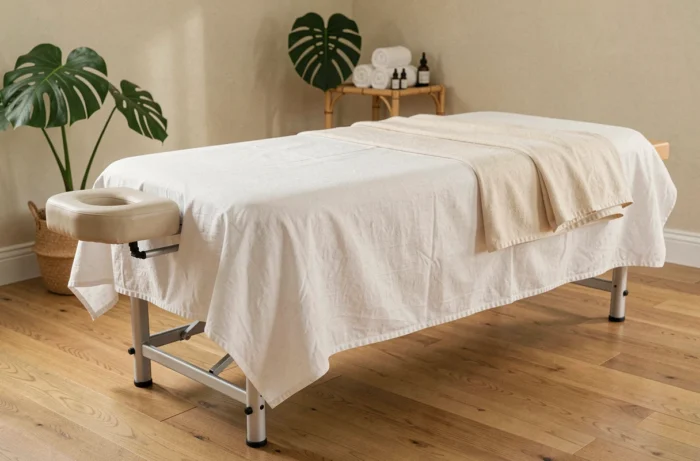
Choosing a massage table for home use is not just about comparing product specifications. The French wellness market has stabilized with a shift towards higher quality equipment. This trend encourages manufacturers to offer models designed for home use, with finishes and adjustments once reserved for professional practices. However, it is essential to know which criteria truly matter when the table is placed in a living room or guest bedroom.
Foam and Covering: What Really Determines the Comfort of a Massage Table
Technical sheets highlight the thickness of the mattress, often expressed in centimeters. But thickness alone does not indicate the quality of comfort. Low-resilience foam collapses after a few months of use, even occasional use. The density of the foam determines the durability of comfort much more than its raw thickness.
Two main types of foam dominate the market: standard polyurethane foam and memory foam. The former offers firm support, suitable for deep tissue massages. The latter conforms to the body’s contours and reduces pressure points, making it better suited for long relaxation sessions at home.
The covering deserves equal attention. PU (polyurethane) synthetic leather dominates the entry and mid-range. It is easy to clean, resistant to massage oils, and does not retain odors.
Field feedback varies: some users report discomfort related to sweating after an hour of use, while others see no issue. PVC, being cheaper, tends to crack more quickly. For regular home use, a detailed comparison is available at latable-de-massage.fr, which lists the technical specifications of the main models on the market.
Folding or Fixed Massage Table: A Choice Dictated by Available Space
The majority of guides lean towards the folding table, presented as the universal solution. This is true for a mobile practitioner. For strictly home use, the question arises differently.
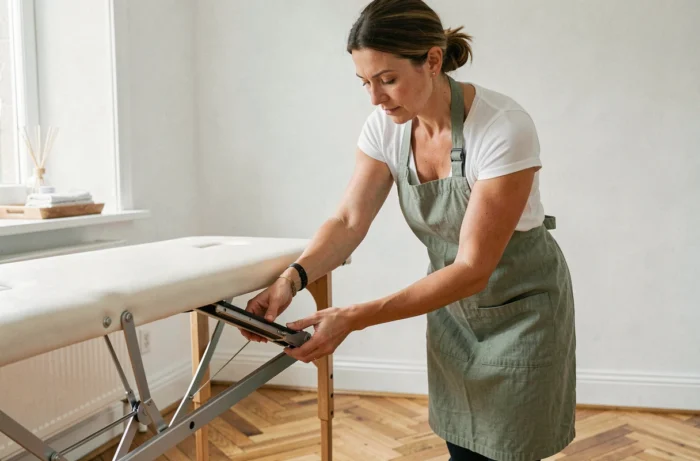
A fixed table offers superior stability. No folding mechanism, no play in the hinges, no squeaking after a few months. If you have a dedicated room (even a small one), a fixed table provides a level of comfort that a folding table cannot match.
However, if the table needs to be stored between uses, the folding option becomes essential. Weight then becomes a major selection criterion. Models with aluminum frames are significantly lighter than wooden tables, making them easier to handle. Maple remains the reference wood for its robustness, but it adds weight to the overall structure.
- Aluminum frame: lightweight, corrosion-resistant, suitable for frequent movement around the house or vertical storage in a closet.
- Wood frame (maple, beech): heavier, more stable once unfolded, providing a superior sense of solidity under the masseur’s hands.
- Mixed frame (steel legs, wooden top): a compromise found in some entry-level fixed models, adequate for occasional use.
Adjustable Height and Ergonomics: Protecting the Masseur as Much as the Recipient
The height of the table is the most underestimated parameter in a home context. An individual massaging a friend often adopts an inappropriate posture, with arms too high or back bent, due to incorrect adjustment.
The correct height is at wrist level, with arms along the body. This simple guideline helps avoid tension in the shoulders and lower back of the masseur. Tables with cable or rack adjustments allow for quick adjustments, whereas screw systems require more manipulation.
Electric models, long confined to clinics, are increasingly appearing in the consumer market. Their advantage: motorized height adjustment, sometimes for the backrest and tilt as well. Their limitation: a significantly higher price and a weight that excludes regular movement. For a home where the table remains in place, electric adjustment provides a measurable ergonomic benefit.
Headrest and Facial Cavity: Details That Change the Session
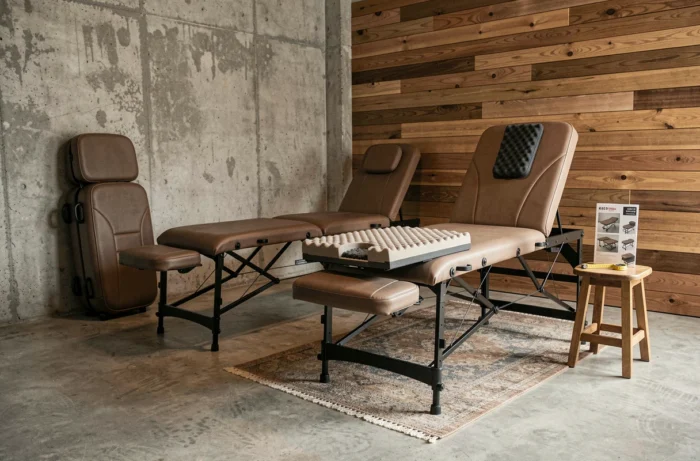
The removable headrest with a crescent cushion allows the recipient to breathe freely in a prone position. A poorly designed model creates pressure on the forehead or cheekbones after twenty minutes.
Check that the headrest tilts at multiple angles. Some models offer a facial cavity integrated directly into the top, without a separate headrest. This configuration reduces the overall length of the table but limits adjustment possibilities.
Maximum Weight Capacity and Safety Standards for a Home Table
The maximum load indicated by the manufacturer is a safety data point, not a marketing argument. In home use, the individuals being massaged come in various sizes. A comfortable weight capacity accommodates all household members without risk.
Tables sold in Europe must comply with regulations regarding general product safety. This point deserves attention when purchasing from an international marketplace, where some third-party sellers do not provide clear identification of a responsible entity established in the European Union.
- Check for the presence of a manual in French with identification of the manufacturer or European importer.
- Prefer models whose maximum load is tested according to an identifiable standard (and not just declared).
- Beware of tables at very low prices that do not display any normative references on their product sheet.
The home massage market continues to structure itself, with an offer that is becoming clearer. The technical criteria remain the same as in clinics (foam, structure, height, stability), but their hierarchy changes: weight, space when stored, and noise level of mechanisms take precedence that professional guides often overlook.
Physically testing a table before purchase remains the most reliable method to assess comfort, as technical specifications cannot replace the feeling of real support.