
A high school student who spends their classes doodling logos in their notebooks, a final-year STD2A student who edits posters for the student office on weekends: these profiles, at the time of Parcoursup, are not looking for a random job. They want a career where their eye and hand contribute to something tangible.
Graphic design captures this energy because it transforms a taste for the visual into a marketable skill, without requiring five years of art school before touching a first real project.
Employability of graphic design after the baccalaureate: a strong signal for creatives
When hesitating between visual arts, animation cinema, or graphic design, the criterion that often sways the decision is the ability to find work quickly. Jobs in visual communication and digital fields have been among the most sought after in the creative sector in recent years. Graphic designer, web designer, graphic artist: these positions are identified as in-demand jobs in recent employment-training analyses.
This demand is explained by a structural need. Every company launching a product, opening a website, or revamping its brand identity needs visuals. Communication agencies, studios, and even internal marketing departments absorb profiles capable of producing coherent materials, from logos to Instagram posts.
It is easier to understand why the appeal of graphic design among creative profiles goes beyond simple artistic passion. For a graduate who wants to live off their creativity without going through a long and uncertain academic path, it is a rational trade-off between vocation and pragmatism.
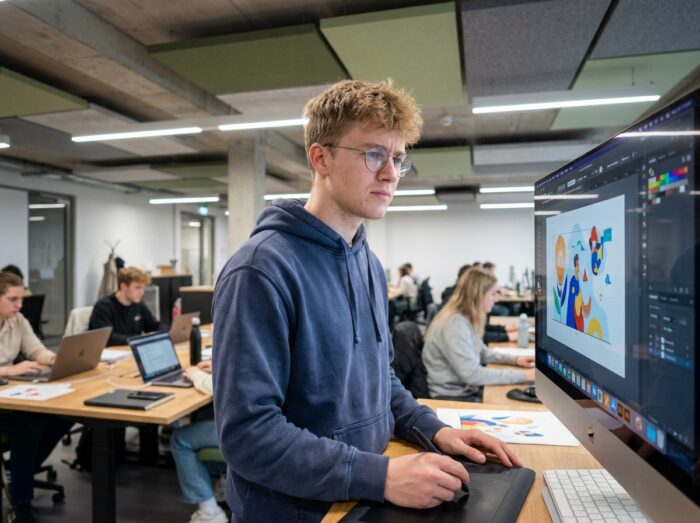
Training in graphic design: DN MADE, bachelor’s degree, or specialized school
The landscape of training has changed since the disappearance of the old BTS graphic design programs. Since 2018, the DN MADE (National Diploma of Arts and Design Trades) has replaced these two-year courses with a three-year cycle aligned with the European bachelor-master-doctorate system. This diploma, awarded by public institutions, covers graphic design, typography, visual identity, and digital tools.
At the same time, private schools offer bachelor’s degrees in graphic design accessible right after high school. These programs, often lasting three years, emphasize project production and the creation of a professional portfolio. Some are conducted entirely online, opening the door for profiles who work alongside their studies or live far from major cities.
Concrete criteria for choosing your training
In the face of the proliferation of schools, it is essential to ask the right questions before enrolling:
- Is the diploma recognized by the State or registered with the RNCP? An unrecognized title complicates further studies and salary negotiations.
- Does the training include real projects with external sponsors? A portfolio filled with school exercises does not convince a recruiter.
- What is the professional insertion rate at six months? Feedback on this point varies between schools, and published figures should be cross-referenced with reviews from former students.
- Do the taught software correspond to market standards (Adobe suite, Figma for UX/UI)?
Skills of the graphic designer: what the market really expects
A creative graduate often imagines graphic design as a purely artistic profession. In practice, the reality is more composite. The graphic designer translates a message into a visual solution, which requires understanding a brief, communicating with a client, and adhering to technical constraints (print formats, screen resolutions, web accessibility).
Mastery of tools like Photoshop, Illustrator, or InDesign remains a prerequisite. However, recruiters also seek profiles capable of working on interfaces (UX/UI design), producing motion design, or adapting a visual identity across multiple digital platforms. Digital versatility distinguishes profiles who secure assignments from those who remain on the sidelines.

Artistic culture and critical eye
Solid training incorporates artistic culture, the history of graphic design, and semiotics. This background is not decorative. It allows one to justify their choices to an art director, understand why a composition works, and avoid reproducing outdated visual codes.
A designer who can explain why they chose one typography over another, based on specific references, gains credibility. This is what separates an executor from a creator.
Career paths and opportunities after training in graphic design
Graphic design does not lead to a single job. After a DN MADE or a bachelor’s degree, one can pursue various positions:
- Graphic designer in a communication agency or creative studio
- Web designer or UI designer in a tech company or startup
- Junior art director, after a few years of experience or a master’s degree
- Freelancer, a status that concerns a significant portion of graphic designers in France
Continuing education remains common. A bachelor’s degree in graphic design opens access to specialized master’s programs in art direction, interaction design, or brand design. Schools like Penninghen, Strate, or the Condé schools offer long cycles that allow for aiming at positions of responsibility.
The France 2030 diagnosis on design professions anticipates several thousand recruitments in art and design jobs in the coming years. This employability signal, combined with the diversity of possible specializations, explains why graphic design remains one of the top choices for graduates with a creative profile.
For a high school student who draws, edits, or composes by reflex, choosing graphic design after the baccalaureate is not a gamble. It is a pathway that structures raw talent into professional competence, with training accessible right after high school and a market that absorbs trained profiles.