
You’ve been chewing for five minutes, you blow, and the bubble immediately pops with a disappointing “pop.” The problem rarely comes from a lack of breath. It’s due to details that most people don’t suspect: the texture of the gum at the moment of blowing, the position of the tongue, or a breath reflex that is too abrupt, causing everything to burst.
Why the bubble pops before it grows: the invisible mistakes
The most common cause of failure has nothing to do with the blowing technique. It’s the preparation of the gum in the mouth that sabotages everything. If the chewing gum hasn’t been chewed long enough, it remains grainy. Micro-zones that are more rigid persist in the dough, and the bubble bursts at these weak points as soon as it starts to stretch.
Another trap: blowing too hard. The natural reflex is to puff out your cheeks and push as much air as possible. As a result, the thin gum membrane undergoes brutal pressure and gives way immediately. A slow and steady breath produces much better bubbles than a powerful breath. Think of the image of a balloon: if you blow sharply, it bursts; if you go gradually, it inflates.
The third mistake concerns saliva. Too much saliva makes the gum soft and sticky, not elastic. Not enough, and it remains dry and brittle. The balance is found by chewing regularly without opening the mouth (which dries out the surface of the chewing gum).
Those who want to delve deeper into the basic mechanics can consult this guide on how to blow bubbles with chewing gum, which details the initial gesture step by step.
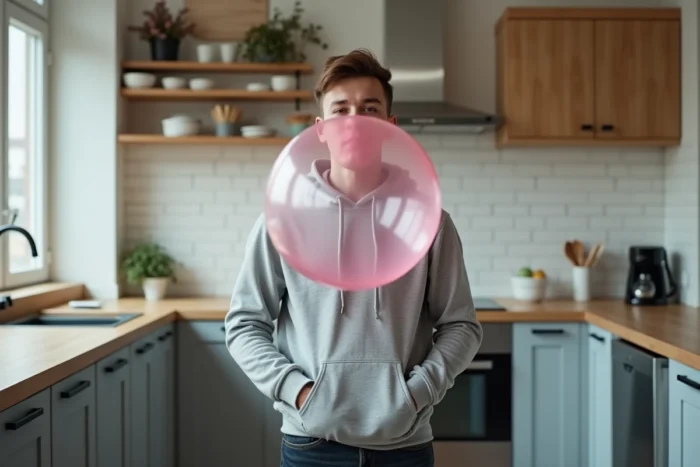
Making big bubbles with regular chewing gum
You may have read that you need to buy a specific bubble gum. It’s true that bubble gum types are formulated for better elasticity. Their gum base stretches more before breaking.
However, a regular chewing gum can work if you adapt the method. The key is to compensate for the lack of elasticity with longer chewing and a thicker disk of gum against the palate.
Adapting the preparation according to the gum
With bubble gum, a few minutes of chewing is enough. With mint chewing gum or sugar-free chewing gum, you need to chew significantly longer to achieve comparable flexibility. The sugar (or substitute) dissolves during chewing, and it’s the remaining gum base that forms the bubble.
The less sugar remains in the dough, the more elastic it is. This is why a chewing gum that has already been well chewed sometimes produces better bubbles than fresh chewing gum. The taste has disappeared, but the ability to form a thin and resilient membrane has increased.
The thickness of the disk changes everything
Before blowing, the tongue flattens the gum against the front teeth and the palate to form a disk. With soft bubble gum, a thin disk is sufficient. With standard chewing gum, keep a slightly thicker layer. A disk that is too thin with a less elastic gum will burst at the first blow.
Blowing technique for bigger chewing gum bubbles
The gesture breaks down into three phases. None are difficult in themselves, but chaining them smoothly requires a bit of practice.
- Form the disk: with your tongue, press the chewed gum against the back of your upper incisors. Spread it by pushing from the center to the edges until you obtain a thin and even disk that covers the opening between your teeth.
- Start the bubble: gently push air with your tongue, not with your lungs. The tongue pulls back very slightly to create a small pocket of air behind the disk. It’s this initial micro-inflation that launches the bubble.
- Blow slowly: once the small pocket is formed, take over with a steady and gentle breath. The bubble should grow without you feeling a sudden resistance. If you feel the membrane tightening abruptly, slow down even more.
Most failures occur at the transition between phase two and phase three. The tongue pulls back too quickly, or the breath comes too early, before the initial pocket is stable.
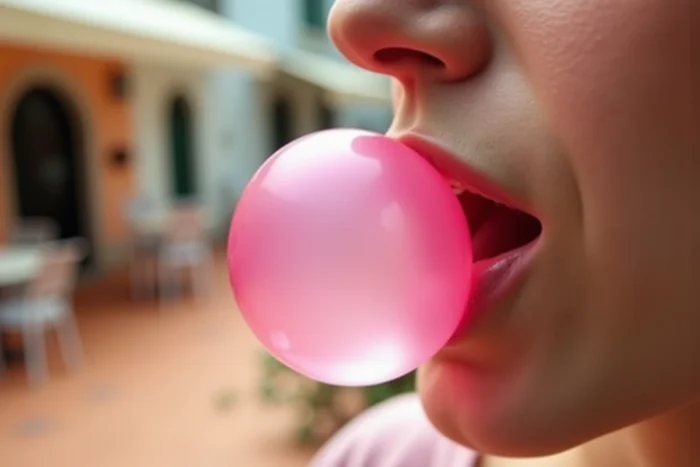
Big chewing gum bubbles: tips to go further
Once the basic technique is mastered, a few adjustments can help increase size.
The amount of gum matters. Two pieces of chewing gum chewed together provide a larger mass, thus a wider disk and a membrane that can stretch further. Three pieces work too, but beyond that, the mass becomes difficult to control with the tongue.
The environment plays a role that is often overlooked. Dry, cool air keeps the membrane stiffer and more resilient. Warm, humid air softens it, and the bubble collapses under its own weight before reaching a nice size.
When the bubble reaches its limit
You may have noticed that at a certain size, the bubble becomes translucent? This is a sign that the membrane is dangerously thinning. At this stage, there are two options: stop blowing to keep a round and stable bubble, or continue while reducing the airflow even more, almost to a trickle.
Retraction of the tongue helps stabilize the bubble when it starts to get big. By slightly pulling back the tongue, you create a buffer space that absorbs small pressure variations.
- Keep your lips slightly moist so the gum doesn’t stick to the skin and burst upon contact.
- Do not move your head while inflating: the slightest sudden movement alters the distribution of air in the bubble.
- If you want a record bubble, do it standing, with your head slightly tilted forward, so gravity pulls the bubble down rather than against your nose.
The maximum size depends primarily on the elasticity of the gum and the consistency of the breath. With good bubble gum and controlled airflow, the bubble can exceed the size of the face. With standard chewing gum, expect more modest results, but quite satisfactory once the technique is refined.