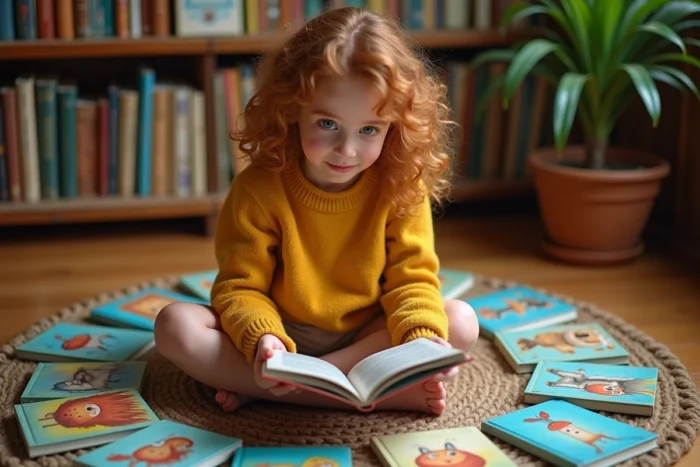
The children’s sections of bookstores overflow with albums featuring meticulous illustrations and well-crafted stories. The choice seems immense, but the vast majority of these works follow a similar pattern: the child listens, turns the pages, closes the book. Reading then remains a pleasant moment, without any extension.
A segment of children’s publishing takes the opposite approach by designing books that encourage the child to act after the last page, to observe their environment, to ask questions, or to create something with their hands.
Children’s books that extend reading through action
The criterion that distinguishes a simply enjoyable album from a children’s book capable of awakening lasting curiosity hinges on a simple question: what does the child do once the book is closed? The most stimulating works incorporate explicit invitations within their narrative or structure to step outside the confines of the page.
Some albums offer guided observation experiences. The child reads a double page about pollinating insects, then the book suggests going outside to a garden or park to spot the described species. Other formats pose open-ended questions aloud, transforming reading into a dialogue between the adult and the child. Books with flaps or animations operate on the same principle: the child manipulates, lifts, searches for an answer before discovering it.
Specialized publishers and booksellers specifically select these works based on their ability to extend reading beyond the book. This approach can be seen at Les Petits Pois Sont Rouges, which focuses its choices on children’s albums and documentaries designed to nourish children’s active imagination.
The difference also lies in the narrative construction. A classic album tells a closed story. A book designed to awaken curiosity intentionally leaves areas of ambiguity, unresolved leads, and “what if?” scenarios that compel the child to formulate their own hypotheses.
Interactive formats and children’s documentaries: what really works
Not all books labeled “interactive” are created equal. A sound book with three buttons does not engage the same cognitive activity as an illustrated documentary that asks the child to draw what they observed outside.
Animated and flap books
Flap books remain among the most effective formats for children aged three to six. The act of lifting a flap creates a micro-suspense that the child resolves themselves. The best works of this type incorporate question-and-answer formats designed for read-aloud sessions, encouraging the child to verbalize before checking under the flap.
A common pitfall: purely decorative flaps, with no connection to a question or reasoning. A useful flap poses a question, while a gimmicky flap just hides an image.
Field-oriented children’s documentaries
A recent trend in children’s publishing connects reading to field exploration. These books function as observation guides: identifying animal tracks in the forest, recognizing clouds, understanding a plant’s life cycle by growing it themselves.
The book becomes a tool for exploration, not an end in itself. This connection between initial wonder and concrete learning distinguishes these documentaries from classic illustrated encyclopedias, which compile information without suggesting a call to action.
- Nature books that offer outdoor observation activities (recognizing tracks, collecting leaves) extend reading through a direct sensory experience.
- Experience albums that incorporate simple manipulations (folding, cutting, assembling) engage fine motor skills in relation to the story told.
- Books with open-ended questions, without a single imposed answer, develop the child’s ability to formulate personal reasoning.
Criteria for choosing an original children’s book to awaken curiosity
In light of the abundance of offerings, a few concrete criteria can help identify a work that will go beyond passive reading.
Check if the book offers at least one concrete activity related to its content: an observation, an open question, a creation. If the child can do nothing but look and listen, the book remains a good album, but not a trigger for active curiosity.
The quality of the illustrations plays a often underestimated role. Accurate naturalistic illustrations (a recognizable insect, a faithfully represented plant) allow the child to make the connection between the book and the real world. Overly stylized illustrations, no matter how beautiful, complicate this transfer.
- The age indicated on the cover provides a guideline, but the child’s attention span and interests matter more. A four-year-old passionate about rocks will get more from a minerals documentary than from an “age-appropriate” album about emotions.
- The physical format of the book matters: a board book withstands repeated handling, a large format facilitates detail observation, and a small format fits into a bag for a nature outing.
- The presence of a narrative thread, even in a documentary, helps the child memorize information. A fact tied to a story is remembered better than an isolated technical sheet.
Children’s reading and exploration: the role of the accompanying adult
A book designed to awaken curiosity only works fully if the adult plays along. Reading aloud while pausing on the questions posed by the book, accepting not to know the answer, suggesting to check together outside or in another book: these simple gestures transform reading into a starting point for exploration.
The adult who says “I don’t know, let’s find out” models exactly the attitude that these books seek to develop in the child. Curiosity does not arise from the book alone, but from the interaction it generates between the child, the adult, and the outside world.
Field feedback varies on this point: some children spontaneously take ownership of the extensions proposed by the book, while others need active support to make the connection between the page and reality. Adapting one’s approach to each child remains the most determining variable in the effectiveness of these works.
The children’s literature market offers enough titles designed to trigger action and reflection. The real selection filter is not found in recommendation lists, but in this question posed before each book: once the last page is turned, what will my child want to do?