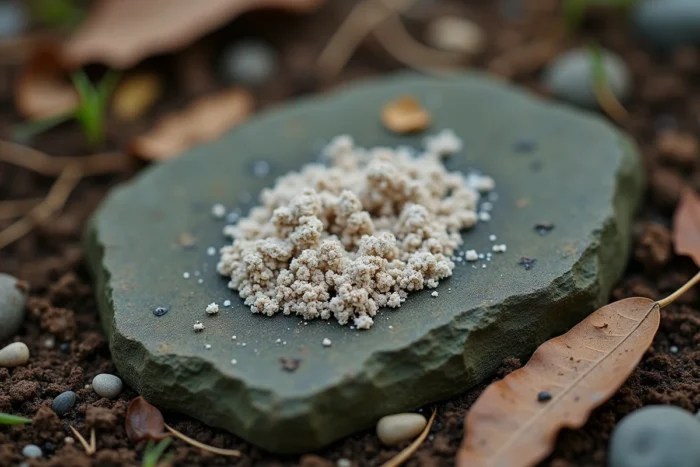
Snake droppings do not resemble those of any other animal commonly found in France. Their physiological composition clearly distinguishes them from the droppings of rodents or birds, but this particularity remains poorly known to the general public. Confusing a grass snake’s excrement with that of a rat or a lizard leads to misinterpretations about the wildlife present in a garden or building.
Uric acid and urates: what makes snake feces unique
Snakes, like all reptiles, do not urinate in the same way as mammals. Their excretory system eliminates nitrogenous waste in the form of solid uric acid rather than dissolved urea. The visible result is urates, a white or cream, chalky mass, often attached to the darker fecal part.
This dual composition is the first reliable criterion for distinguishing snake excrement from rodent droppings. A rat or mouse dropping is homogeneous, uniformly dark, with no white portion. In snakes, the coexistence of a dark brown area and a whitish area in the same mass is almost a systematic signature.
The proportion of urates varies depending on the hydration of the animal and the time since its last meal. A well-hydrated snake sometimes produces more liquid, almost paste-like urates. In contrast, an individual in a prolonged fasting period may primarily excrete urates with very little fecal matter. To reliably identify snake droppings, it is this bicolor association that should be sought first.
Shape and content of snake droppings according to diet
A snake swallows its prey whole. Its digestive system dissolves soft tissues with remarkable efficiency, but some elements partially resist digestion. This gives snake droppings their very particular appearance.
Wild snakes: visible remains to the naked eye
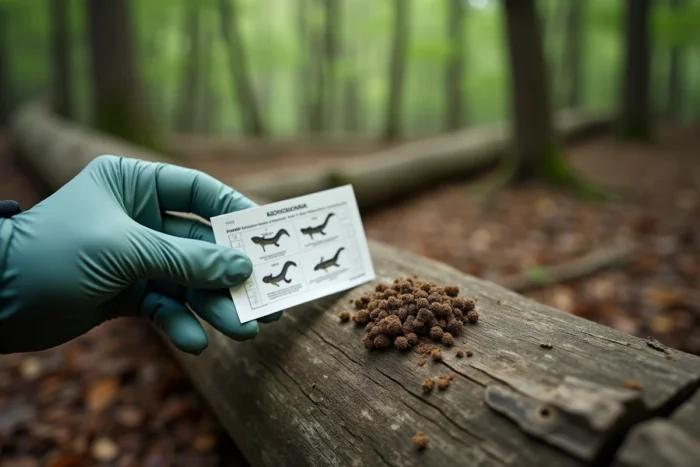
In wild grass snakes and vipers, the feces regularly contain fragments of bones, fur, or feathers that are poorly digested. These residues are sometimes identifiable: a small bone from a micromammal, a tuft of fur from a vole, amphibian scales. The overall shape is elongated, irregular, without the granular consistency of rodent droppings.
The size of the excrement directly depends on the size of the ingested prey and the size of the snake. A collar snake that has consumed a frog will produce a larger and wetter mass than an asp viper after a meal of a vole.
Captive snakes: a more standardized appearance
Captive snakes, fed with standardized prey (usually frozen-thawed mice), produce more regular-sized and consistent droppings. Reptile owners are well aware of this appearance: a compact, dark brown fecal portion accompanied by distinct white urates. Bone fragments are still present but less varied than in a wild individual with a diverse diet.
Common confusions with the droppings of other animals
In the field, several types of droppings can be confusing. The table below summarizes the observable differences without specific equipment.
| Animal | Shape | Color | Presence of white urates | Visible content |
|---|---|---|---|---|
| Snake | Elongated, irregular | Dark brown + chalky white | Yes (systematic) | Bones, fur, feathers |
| Rat | Oblong, regular | Uniform dark brown | No | No visible fragments |
| Lizard | Small, rounded | Dark brown + white tip | Yes (terminal tip) | Insect fragments |
| Bird (raptor) | Regurgitated pellet + droppings | Gray/white | No (but white droppings) | Bones, fur (in the pellet) |
The most common confusion is between snakes and lizards. Both are reptiles and produce urates. The difference lies in size (significantly smaller in lizards) and content: insect remains in lizards versus vertebrate remains in snakes.
With rodent droppings, the error mainly comes from color. A fresh rat dropping is dark and shiny, which can resemble the fecal portion of a snake if the urates have been dispersed by rain or the passage of an animal. In this case, looking for bone fragments in the material remains the best clue.
Where to find snake droppings in France
Snakes do not defecate while moving like some rodents. They usually do so in resting areas or near their shelter. A few typical locations deserve special attention:
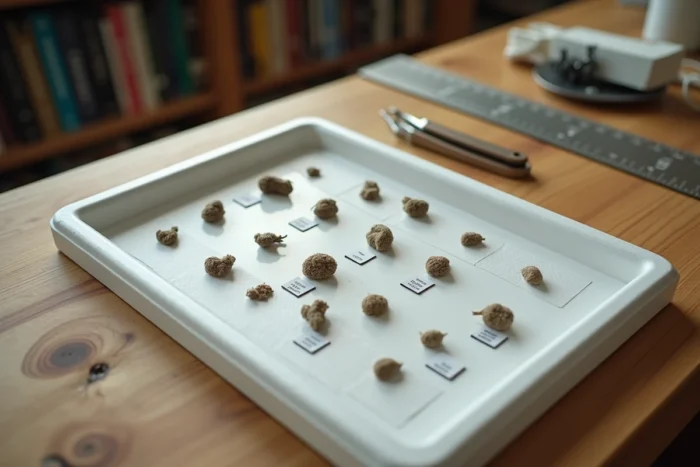
- Under corrugated sheets, tarps, or plates laid on the ground, used by herpetologists as artificial shelters for monitoring populations
- In stone piles, dry stone walls, or piles of dead wood where snakes thermoregulate
- Under wooden decks, in crawl spaces, or along foundations exposed to the south
- Near water points (ponds, ditches) for semi-aquatic species like the grass snake
The frequency of droppings is low compared to mammals. A snake that feeds once or twice a month produces only one dropping per digested meal, usually several days after ingestion. Finding snake droppings regularly in the same place indicates an established resting site rather than a simple passage.
Limits of visual identification without analysis
Identification by appearance remains a useful but imperfect field approach. Droppings exposed to the elements quickly lose their urates, making it much more difficult to distinguish them from other droppings. Desiccation also alters the shape and color within a few days.
Determining the species of snake from its droppings alone is rarely possible without further analysis. Size gives a rough indication of the animal’s size, and content can suggest a diet (amphibians, rodents), but the available data do not allow for a definitive conclusion about the species using this method alone.
For situations where precise identification matters (suspected presence of a viper in a garden frequented by children, for example), consulting a herpetologist or a local naturalist association remains the most reliable approach. The droppings, combined with other clues such as sheds or tracks, provide a much more exploitable set of elements than an isolated dropping.