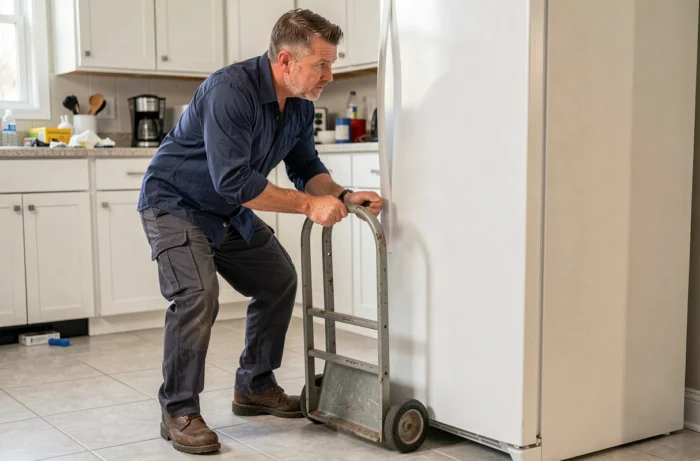
A refrigerator often weighs more than one might imagine. Lifting it with your arms exposes you to back pain, scratches on the floor, and damage to the appliance itself. The hand truck remains the most suitable tool for moving this type of load vertically, provided you choose the right model and follow a few precise steps.
Inclination and compressor: what the fridge cannot tolerate
Before even touching the hand truck, it’s important to understand why a refrigerator does not move like a cardboard box. The compressor, located at the back bottom of the appliance, contains oil that circulates in a closed circuit with the refrigerant.
When the fridge tilts beyond a certain angle, this oil rises into the cooling ducts. If it reaches the refrigeration circuit, it can cause a blockage or permanently damage the compressor.
The maximum recommended tilt is 45 degrees, with the motor facing down. This is exactly the angle that a well-used hand truck allows you to maintain. Transporting it flat, lying down in a truck for example, multiplies the risks of failure after reconnection. If you need to use a hand truck to transport a fridge, this angle constraint guides all the following steps.
Hand truck suitable for the fridge: concrete selection criteria
Not all hand trucks are suitable. A small folding hand truck designed for bags of potting soil may give way or tip under the weight of a standard refrigerator.
Load capacity
A typical refrigerator generally weighs between 70 and 120 kg, while an American model can exceed 100 kg and reach much higher weights. The hand truck must have a load capacity greater than the actual weight of the appliance, with a safety margin. Check the technical label of the fridge or its product sheet to know its exact weight.
The base and straps
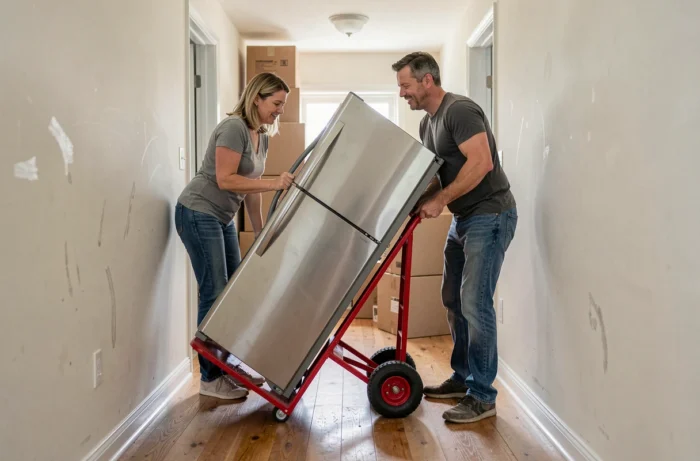
The base is the small platform at the bottom of the hand truck on which the load rests. For a fridge, it must be wide and deep enough to accommodate the base of the appliance without it hanging over. A hand truck with a narrow base leaves the fridge unstable and increases the risk of a lateral fall.
The straps are the second point to check. Without a securing strap, the fridge can slide backward as soon as you tilt the hand truck. Some models come with a ratchet strap, while others require the separate purchase of a strong textile strap.
The wheels
Are you planning to cross a door threshold, a sidewalk, or stairs? The wheels make all the difference. Here’s what to look for:
- Pneumatic (inflatable) wheels absorb shocks better and navigate more easily over uneven surfaces, like a gravel path or a raised sidewalk.
- Solid rubber wheels are sufficient on flat surfaces (indoors, parking) and are unlikely to puncture.
- For stair navigation, a stair-climbing hand truck with three rotating wheels on each side makes it easier to go down step by step without carrying the entire weight.
Positioning the fridge on the hand truck safely
The initial positioning is the most delicate phase. You are standing in front of the fridge, and the hand truck is ready. Here’s how to proceed concretely.
Start by completely emptying the refrigerator. Even a forgotten jar of jam can spill and block a door or unnecessarily add weight to the appliance. Unplug it, let it defrost, and then clean the interior to prevent mold during transport.
Secure the fridge doors with wide tape or a strap. A door that opens during transport destabilizes the load and damages the hinges.
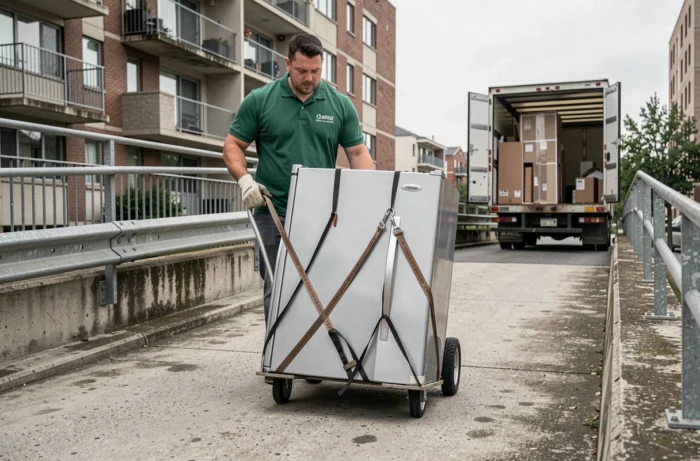
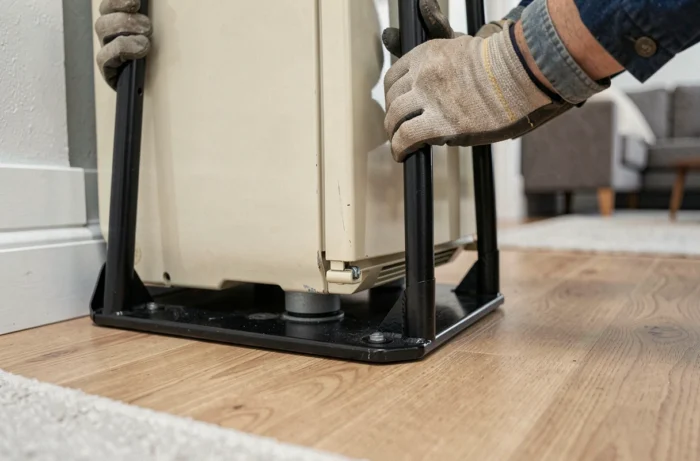
Slide the base of the hand truck under the bottom of the refrigerator, with the compressor side facing down. Gently tilt the fridge backward so that it rests against the vertical structure of the hand truck. Wrap the strap around the appliance and tighten it securely, without crushing the walls.
Why the compressor side down? Because this position keeps the oil in the compressor during the entire tilt. If the compressor ends up on top, the oil flows into the circuit, exactly the scenario to avoid.
Crossing stairs or a threshold with a fridge on a hand truck
Moving on flat ground usually poses no problem once the fridge is strapped. The real difficulty begins at the first obstacle: step, door threshold, stairs.
On a low threshold (a few centimeters), slightly tilt the hand truck backward and push the wheels against the obstacle. A controlled rocking motion allows you to cross the step smoothly.
For a full staircase, always work with at least two people. The person at the top guides and holds, while the one at the bottom controls the tilt and pace. Go down step by step, placing the wheels on each landing before moving to the next one.
A standard two-wheel hand truck works but requires sustained physical effort. Models with tracks or rotating wheels significantly reduce this effort by distributing the descent over several successive support points.
- Protect the walls and corners with moving blankets or thick cardboard.
- Never pull the hand truck upward when going up stairs: push it from below.
- Take breaks on the landings to adjust the strap if it loosens.
Reconnecting the fridge after transport: the waiting period to respect
The transport is complete, and the fridge is in place. The temptation to plug it back in immediately is strong, especially if food is waiting to be kept cool.
Wait at least several hours before turning the fridge back on. This waiting period allows any oil that may have moved in the circuit to return to the compressor. The manufacturer’s manual remains the primary reference for knowing the exact time. For older models, a 24-hour waiting period is often recommended.
Place the refrigerator in its final position before plugging it in, leaving a few centimeters of space behind for the compressor’s ventilation. Moving it a second time after starting it would restart the oil circulation problem.
A well-chosen hand truck and a rigorous method transform a physically risky operation into a controlled move. The fridge arrives intact, and so does your back.