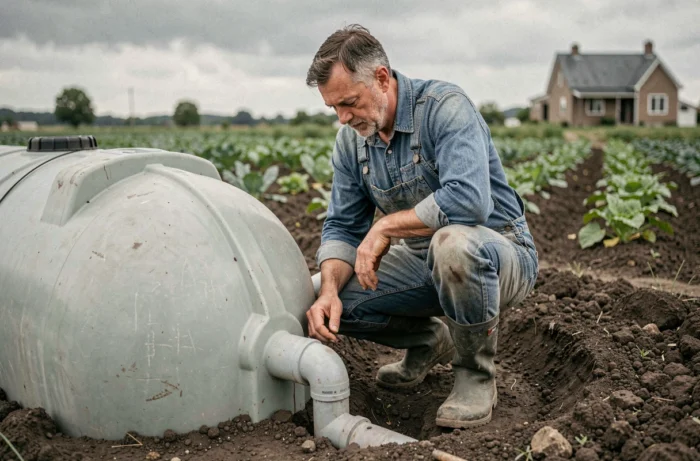
Collecting rainwater on a farm poses no major technical difficulties. However, truly optimizing the volume stored and returned to crops with an underground tank requires considering several parameters that product sheets do not display: actual usable volume, quality of the stored water, connection to the irrigation network, and maintenance constraints. This article compares the variables that separate a high-performing installation from a simple underground reservoir.
Usable volume of an agricultural underground tank: the gap with the nominal volume
The first instinct is to choose a tank based on its stated capacity. This data corresponds to the nominal volume, which is the total geometric volume of the envelope. The usable volume is always less than the nominal volume, sometimes significantly so.
Several elements reduce the actually usable capacity:
- The space reserved for sediments at the bottom of the tank, which accumulate from runoff from agricultural roofs (dust, plant debris, mineral residues).
- The internal access components (suction strainer, overflow, connections) that occupy a significant volume in compact models.
- The internal geometry: an oval or conical-bottomed tank does not fill like a perfect cylinder, and the lower area often remains inaccessible to the pump.
To correctly size an installation intended for irrigation, one must start from the water needs during the critical period (usually June-August), then work back to the necessary usable volume, and finally to the corresponding nominal volume. Reasoning in the opposite direction, from the catalog to the field, leads to undersizing the storage.
The storage of rainwater in agriculture becomes more reliable when this calculation also includes the actual collection coefficient of the roof, which depends on the roofing material and its slope.
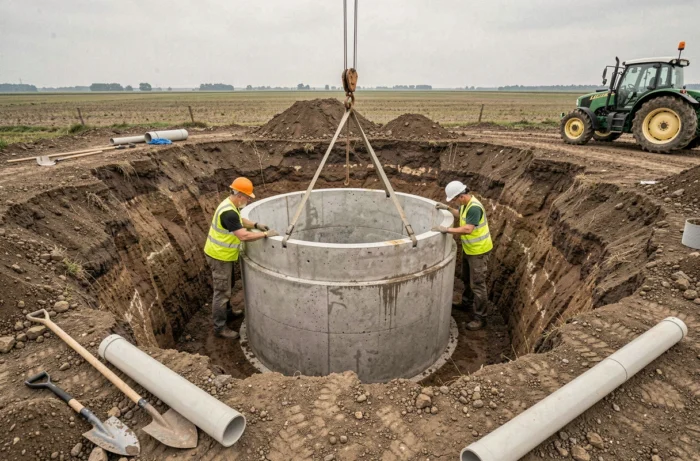
Concrete tank, polyethylene tank, flexible tank: comparison for agricultural use
The choice of material affects the lifespan, mechanical behavior in the soil, and the quality of the stored water. Here is a synthetic comparison of the three most common solutions on farms.
| Criterion | Concrete | Polyethylene (PEHD) | Flexible tank |
|---|---|---|---|
| Soil pressure resistance | Very high | Medium to good (depending on thickness) | Low (semi-buried installation) |
| pH neutralization | Yes (buffer effect of limestone) | No | No |
| Empty weight | High (lifting equipment required) | Low to medium | Very low |
| Internal maintenance | Access through a manhole, cleaning possible | Limited access on small models | Complete drainage necessary |
| Estimated lifespan | Several decades | Variable depending on UV quality and soil | Shorter in intensive use |
Concrete offers an often underestimated advantage: its natural alkalinity limits bacterial growth in the stored water. For animal watering or irrigation of vegetable crops, this parameter weighs in the balance.
In contrast, high-density polyethylene appeals due to its lightness and low installation cost, but it requires increased vigilance regarding water quality over the years, especially if the tank is not equipped with an effective upstream filter.
Separation of networks and regulatory compliance: a technical point often overlooked
Connecting a rainwater tank to an irrigation or watering system is not just about installing a pump and a pipe. French regulations impose a strict separation between the rainwater network and the drinking water network.
Specifically, the pipes carrying rainwater must be distinctly identified (color, marking) and must never be connected, even temporarily, to the public supply network. This compliance point is often absent from content focused on “tank choice,” while a failure to separate exposes the operator to sanctions and a real health risk.
On farms that use stored water for multiple purposes (cleaning premises, irrigation, watering), the design of the network downstream of the tank deserves as much attention as the tank itself. Each use must have its own identified line, with accessible shut-off valves.
Preventive maintenance of an underground tank: what conditions durability
A well-sized and properly installed underground tank can function for decades. The condition: integrate maintenance from the design phase, not after commissioning.
Three technical elements make a difference in the long term:
- Inspection points must allow visual control of the sediment level without complete drainage. An undersized access manhole complicates any subsequent intervention.
- The upstream filtration device (leaf filter, screen, self-cleaning filter) reduces the load of suspended solids and spaces out the cleaning operations.
- The autumn purge of the irrigation network connected to the tank protects the buried pipes from frost damage. This simple gesture, often forgotten, avoids costly repairs the following spring.
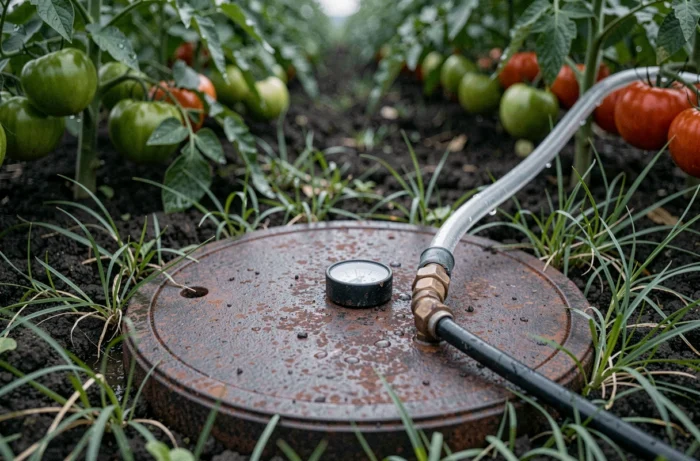
Cleaning the bottom of the tank, to be done every few years depending on the collected flow and the quality of the filtration, remains the heaviest operation. Planning sufficient access from the installation (manhole diameter, position relative to buildings) avoids the need for further excavation for intervention.
Optimizing rainwater storage in agriculture does not rely on a single spectacular parameter. It results from the alignment between a correctly calculated usable volume, a material suited to the soil and uses, an installation compliant with the requirements for network separation, and an anticipated maintenance plan. It is the coherence of the whole that determines the actual performance of the installation over time.