
The string trimmer is the tool that makes the difference between a mowed garden and a truly well-maintained garden. It works where the lawn mower cannot reach: along walls, at the base of trees, between the slabs of a pathway. Choosing the right model depends less on the brand than on three technical parameters that are often poorly prioritized: the type of motorization, the cutting system, and the battery compatibility with other tools.
Battery platforms and multi-tool compatibility: the criterion that product sheets minimize
The underlying trend in the battery-powered string trimmer market is no longer raw power. Manufacturers are now directing their ranges towards removable battery platforms compatible across tools. The same battery can power the string trimmer, brush cutter, blower, or chainsaw of the same brand.
This system reduces the number of chargers needed and decreases the overall equipment cost. However, it creates a dependency on the manufacturer’s ecosystem. Switching brands means having to repurchase the entire battery inventory.
Recent manufacturer pages also emphasize partial storage and frost protection, indicating that battery durability is becoming a central purchasing criterion. Before comparing the prices of the string trimmers themselves, checking if the offered battery integrates into an existing ecosystem can save several dozen euros. To cross-reference models and compatibilities, specialized comparisons like those published on taille-bordure-warrior.com facilitate this cross-checking work.

Electric, battery, or gas string trimmer: what motorization really changes
The debate between corded electric, battery, and gas motorization structures the entire offering. Each type meets a specific use, and confusing them leads to unsuitable purchases.
Corded electric model for small gardens
The corded electric string trimmer remains the lightest and most affordable. Its power is more than sufficient for soft grass along a terrace or flower bed. The power cord limits the range, making it suitable for modest areas.
Battery model for versatility
The battery-powered string trimmer offers complete freedom of movement. Common voltages (18 V or 36 V) cover the majority of domestic uses. The autonomy varies according to the battery capacity, and this is where multi-tool compatibility makes sense: a high-capacity battery purchased for another tool can be used on the string trimmer.
Gas model for dense vegetation
The gas string trimmer delivers the highest power. It is suitable for overgrown areas, tall grasses, and borders invaded by tough vegetation. Its weight, noise level, and mechanical maintenance (air filter, spark plug, fuel mix) make it suitable for regular users or larger areas.
A poorly maintained gas model overheats and loses performance. Husqvarna recommends regularly cleaning the air intakes and cooling fins, increasing the frequency in dusty conditions or with a lot of plant debris.
Line, blades, or knife: the cutting system suited for each lawn
The type of motorization is not enough to choose a string trimmer. The cutting system determines the quality of the finish and resistance against different types of vegetation.
- The nylon line is the most common. It cuts grass by rotating at high speed and is easily replaceable. The larger the diameter of the line, the more it resists thick grasses. For a classic lawn, a standard line is sufficient.
- Plastic blades replace the line on some battery models. They provide a clean cut on soft grass but wear out quickly when in contact with woody stems or stones.
- The metal knife, available on brush cutters and some high-end gas string trimmers, slices through brambles, nettles, and low brush. It turns the tool into a true brush cutter.
For a regularly maintained garden, nylon line remains the best compromise between cost and efficiency. Blades or knives are justified only if the vegetation exceeds the stage of classic grass.
Terrain behavior: usage conditions that manuals do not explain
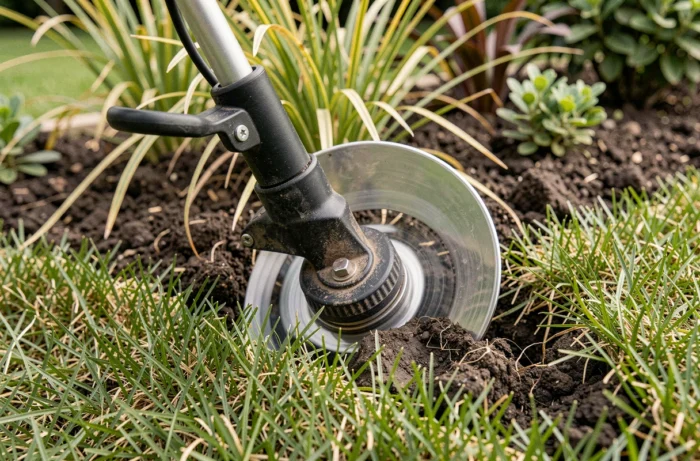
Practical feedback indicates a point rarely documented in technical sheets: the string trimmer performs better on slightly damp soil than on completely dry soil. Wet grass offers less resistance to the line and cuts more cleanly. However, working on waterlogged ground causes clogs and throws dirt onto the casing.
The cutting width also plays a concrete role. A generous width (over 30 cm) speeds up work on long border lengths. For finishing touches at the base of a wall or between tight slabs, a narrower cutting head offers more precision.
Ergonomics determine the duration of use without fatigue. A harness or adjustable auxiliary handle allows for longer working sessions, especially with a gas model whose weight significantly exceeds that of an electric model. Testing the grip before purchase, if possible in-store, avoids unpleasant surprises.
String trimmer and brush cutter: when the old tool is no longer enough
The boundary between string trimmer and brush cutter is blurring on recent models. Some manufacturers offer interchangeable heads that transform a string trimmer into a brush cutter in seconds.
The distinction remains relevant for the initial choice. A classic string trimmer is sufficient for maintaining an already mowed lawn and neatly cutting edges. The brush cutter is necessary as soon as the vegetation exceeds ankle height or when the terrain has areas that have never been mowed.
Choosing a model with an interchangeable head may seem ideal, but field feedback varies on this point. The head attachment may have play after several changes, degrading the cutting quality. For use primarily focused on edges, a dedicated string trimmer with good nylon line provides more consistent results than a versatile tool used in all capacities.
The last parameter not to be overlooked is the availability of consumables: line spools, replacement blades, compatible batteries. A model whose parts are easily found in garden centers or online extends the tool’s lifespan well beyond the manufacturer’s warranty.