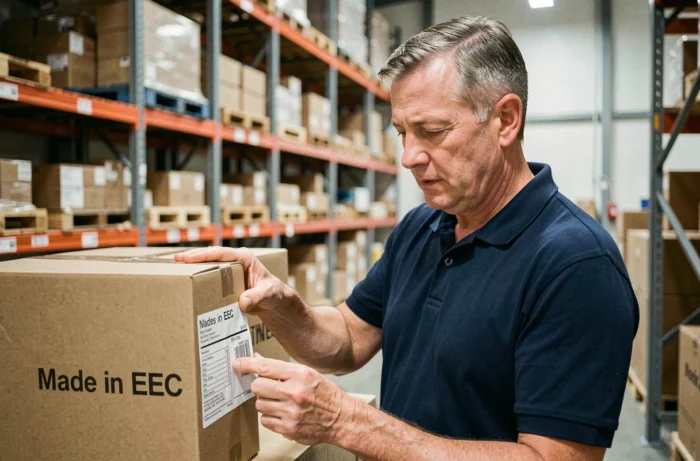
The marking “Made in EEC” refers to the European Economic Community, a legal entity that ceased to exist with the Maastricht Treaty. Any company that still uses this label on its products or packaging operates with an outdated reference. We regularly observe confusion between this historical marking and the current mechanisms of the European single market, which creates real risks in customs and trade matters.
Non-preferential origin rules and product marking in the European Union
The marking of origin in the European Union is based on the non-preferential origin rules defined by the Union Customs Code. A product obtains the origin of a country when it has undergone its last substantial transformation there. This notion of substantial transformation varies according to categories of goods and relies on specific technical criteria: change in tariff classification, value-added threshold, or specific manufacturing operation.
In member states, indicating the country of manufacture on a manufactured product remains optional, except for certain food products subject to sector regulations. This freedom does not exempt compliance with the rules: an erroneous or misleading voluntary origin marking exposes the company to sanctions for unfair commercial practices.
Understanding the meaning of made in eec requires placing it within this legal framework, as the label referred to the same customs mechanisms that were applied at the time to the scope of the EEC. Today, the “Made in EU” or “Made in (Member State)” framework prevails.
Documentary proof of origin: the real operational challenge for companies

Most articles on the subject focus on marketing or consumer trust. In practice, the main risk lies in the documentation of the supply chain. Companies claiming European origin for their products must be able to prove, with supporting documents, that the last substantial transformation indeed took place in the declared territory.
This documentary requirement engages several levels of the company:
- Purchasing must trace the origin of components and raw materials from each supplier, including second and third-tier subcontractors.
- Production must keep documents certifying the transformation operations carried out on the territory (manufacturing records, assembly certificates).
- The customs or logistics department must be able to produce compliant evidence during inspections, under penalty of losing access to public markets or support schemes.
We recommend mapping the value chain before any claim of origin. An error at this stage can lead to tariff reclassification, additional customs duties, and the loss of contracts, especially in public markets where origin criteria become eligibility filters.
European preference and low-carbon criteria in public procurement
The concept of “Made in Europe” has taken on a strategic dimension with the recent industrial policies of the European Commission. The stated goal is to raise the share of manufacturing industry in the EU’s GDP to 20% by 2035, up from 14.3% in 2024. This figure reflects the ambition and explains why the origin of products is no longer just a labeling argument.
The logic of European preference is now structured around two axes. The first concerns public procurement: origin and local content criteria can condition access to tenders. The second relates to public aid and investment support, where low-carbon criteria are added to geographical origin requirements.
For a French company, this means that the origin label (whether “Made in France” or “Made in EU”) becomes a direct commercial competitiveness criterion, not just a marketing lever. Subcontracting SMEs supplying contractors subject to these requirements must anticipate requests for documentary proof.

From “Made in EEC” to “Made in EU”: what changes concretely for labeling
The label “Made in EEC” no longer has any legal value. It still appears on old products, residual stocks, or vintage items. A new product bearing the label “Made in EEC” is non-compliant with the current institutional vocabulary and may be considered misleading.
The transition from the EEC to the European Union has changed the geographical reference scope. Countries that were not members of the EEC are now part of the EU. Conversely, the United Kingdom, a historic member of the EEC, is no longer in the Union. A company using “Made in EEC” to suggest British manufacturing would be making a double mistake: obsolete terminology and potentially inaccurate origin.
In terms of compliance, companies must check three points before affixing an origin marking:
- The terminology used corresponds to the current legal framework (“EU”, “European Union”, “EU” in English, or the name of the Member State).
- The substantial transformation is indeed carried out in the indicated country, in accordance with applicable customs rules.
- The supporting documentation is accessible and up-to-date in case of customs inspection or commercial dispute.
Recent crises (health disruptions, conflict in Ukraine) have highlighted the continent’s dependence on external suppliers for strategic goods. This context increases pressure on companies to ensure the reliability of their origin declarations and anticipate regulatory changes related to European industrial policy.
Origin marking remains a powerful commercial tool, provided it is based on documented reality. Companies that treat this issue as a mere labeling choice expose themselves to customs blockages and exclusion from markets that are increasingly structured around European preference.