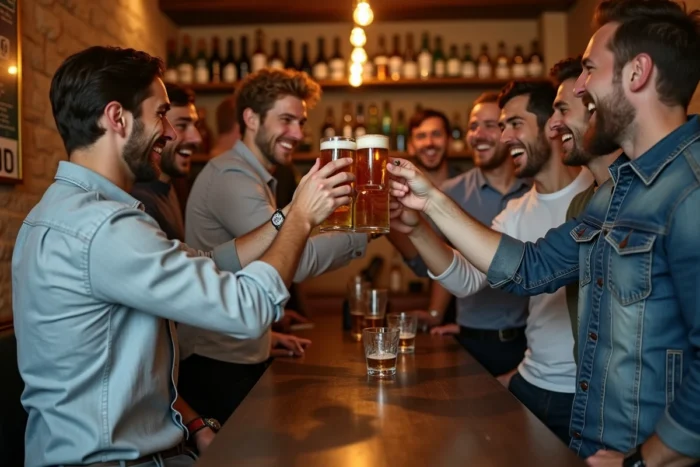
When organizing a bachelor party in Paris for a group of twelve people, half of whom do not know each other, the real challenge is not finding an activity. It’s finding one that works for very different profiles without anyone losing interest after twenty minutes.
There is no shortage of activity lists, but most pile on options without addressing the crucial question: how to transform a heterogeneous group into a cohesive team for an afternoon.
Privatization of unusual venues in Paris for a customized bachelor party
Team-building platforms like Privateaser or Keys Venue now offer their spaces to private groups, including bachelor parties. We’re talking about immersive 360° rooms, rooftops, wine museums with activities, with capacities ranging from twenty to seventy people. This shift towards festive groups has emerged in recent seasons, and it changes the game.
The concrete advantage: privatizing a venue allows you to control the pace of the evening. You are not dependent on a one-hour slot in a crowded escape game. You set the group in a dedicated space, and you can seamlessly transition between formats (quizzes, challenges, aperitifs) without forced breaks.
The rental budget often starts around 1,500 euros excluding tax for an evening. For a group of fifteen, that comes to about a hundred euros per person, drinks not included. When looking for activities for a bachelor party in Paris that break away from the catalog format, this option is worth exploring as a priority.

Hybrid formats for team-building and bachelor parties: immersive quizzes and scripted rallies
The rising format in Paris over the past two years is the hybrid activity. Providers initially focused on corporate team-building (Spotlag, Quiz Room, MadCityZen) are now opening their slots to bachelor parties. You can find urban puzzle games like “The Puzzles of the Latin Quarter” at Spotlag, immersive quizzes in rooms, or scripted rallies in historic districts.
These formats work for heterogeneous groups because they require neither specific physical condition nor particular skills. The sporty friend and the introverted brother-in-law participate at the same level. Team competition creates a bond without forcing intimacy.
Immersive quiz in a private room
The principle: a closed room, buzzers, themed rounds (general knowledge, music, personalized questions about the groom). The session generally lasts between one hour and one and a half hours. The experience is similar to a blind test but more structured, with a host managing the pace.
The strong point for a bachelor party is personalization. Most providers agree to include questions about the groom, turning the quiz into a good-natured roast. Feedback on this point varies among providers, but those who offer a prior exchange with the organizer provide a much better experience.
Scripted rally in Paris
An urban rally gets the group moving without anyone realizing it. You traverse two or three districts, solve puzzles related to the history of the area, and accumulate points. The format lasts between two and three hours, ideal for filling the afternoon before the evening.
The logistical advantage: no need to book a venue. The playground is Paris. Montmartre, the Latin Quarter, the Marais, each neighborhood offers a different backdrop and an atmosphere that fits the group’s profile more or less.
Immersive experiences and specialized bachelor party escape games in Paris
Classic escape games pose a recurring problem for bachelor parties: the maximum capacity per room is often around six people. For a group of twelve or fifteen, you end up splitting the team, which disrupts the collective dynamic.
Actors like Murderama or Escape City have recently positioned themselves explicitly for bachelor parties, with formats adapted for large groups. You can also find broader immersive experiences (live-action games, scripted investigations) that accept groups of twenty people in the same space.
- Escape game in parallel teams: two groups play the same scenario simultaneously, with a final ranking. The competition between teams replaces the frustration of separation.
- Immersive investigation games like Murderama: a more theatrical format, with actors and a storyline that adapts to the group’s reactions. The experience lasts longer than a standard escape game.
- Collective virtual reality experiences: some Parisian venues offer VR sessions for groups, with cooperative or competitive scenarios tailored for parties.
Subtle or moderate bachelor parties in Paris: a trend that is taking hold
It’s rarely mentioned in bachelor party guides, but the demand for low or non-alcoholic formats is clearly increasing. Grooms who do not drink (or no longer do), groups with varied consumption profiles, organizers who want to avoid the next day’s fiasco: the reasons are numerous.
In practical terms, this does not mean a boring bachelor party. Physical activities (axe throwing, paintball, karting) and immersive formats work just as well without alcohol. Some providers offer mocktail bars integrated into their packages, and privatized venues generally allow you to bring your own drinks, alcoholic or not.
The key is mainly not to build the program around alcohol as the main activity. When the schedule stands on its own without a bar crawl, the group enjoys each step more and the groom remembers it the next day.
Logistical checklist for a successful bachelor party in Paris
Before booking anything, here are a few points to check:
- Actual capacity of the venue or activity for your group size (ask for the exact number, not the marketing range).
- Accessibility by public transport: a venue located far in the suburbs complicates travel for a group unfamiliar with Paris.
- Possibility of personalization: integrating elements about the groom transforms a generic activity into a memorable moment.
- Cancellation policy: with a group of ten to twenty people, last-minute dropouts are common.
A successful bachelor party in Paris relies less on the choice of a spectacular activity than on the logical sequence between the steps. A unifying activity in the afternoon, a privatized venue in the evening, a format that includes everyone without forcing anyone: it’s this architecture that makes the difference between a good memory and a collective chore.