Cocooning decor is no longer just about piling blankets on a sofa. Recent trends incorporate dimensions long overlooked by traditional decor guides: acoustics, lighting aligned with biological rhythms, and materials whose durability conditions long-term comfort. Transforming an interior into a warm cocoon requires going beyond the visible surface to act on what we feel without necessarily seeing it.
Sensory comfort beyond the visual: acoustics and circadian light
Most decor advice focuses on colors, textures, and furniture. Cocooning comfort as it evolves since 2025 also encompasses the sound environment and the quality of artificial light.
A living room with bare walls and a hard floor reflects sound aggressively, even if the colors are soft. Adding thick curtains, a long-pile rug, or felt wall panels reduces reverberation and alters the perception of space. Acoustics influence the feeling of refuge as much as the color palette.
On the lighting side, the trend goes beyond the simple recommendation of “warm light.” Circadian rhythm lighting systems offer a color temperature that changes throughout the day: cooler in the morning, gradually warmer in the evening. This type of device exists in the form of smart bulbs compatible with most existing fixtures.
Several resources compile concrete ideas for each room in the house. For example, on the home page of Elle Est Belle La Vie, you can find approaches that intersect decoration and domestic well-being, integrating these often-neglected sensory dimensions.
Biophilic design in a cocooning interior: beyond potted plants
Placing a ficus in a corner of the living room is no longer enough to claim a “nature” interior. Biophilic design, as practiced in recent projects, integrates vegetation into the very structure of the space.
Green walls and modular structures
Stabilized green walls (moss, lichen) require neither watering nor direct light. They provide an organic texture and contribute to acoustic absorption, which ties back to the previous point. Modular structures allow for the integration of live plants into shelves or partitions without sacrificing floor space.
Raw materials and natural textures
Wood, stone, linen, boucle wool: these materials create a cocooning atmosphere through their irregularity. A solid wood table top with visible knots, a stone veneer wall, a crumpled linen cushion – the imperfection of natural materials generates a warmth that synthetic materials cannot replicate.
Field feedback diverges on this point: some decorators prefer smooth, clean finishes for a modern look, while others embrace the raw. The choice depends on the balance sought between contemporary and rustic.
Material durability: a central criterion for a cozy atmosphere
Recent trends increasingly associate cocooning with the longevity of decor choices. A sofa whose fabric pills after two seasons, a blanket that distorts after the first wash: these disappointments degrade the cozy atmosphere faster than a poor color choice.
- Certified and recycled textiles: upholstery fabrics made from recycled fibers (polyester from bottles, regenerated wool) now offer textures comparable to virgin fibers, often with superior wear resistance.
- Certified wood and natural finishes: oils and waxes replace synthetic varnishes on cocooning furniture. They allow for the renovation of a damaged surface without full sanding, extending the furniture’s lifespan.
- Embracing second-hand: hunting for a vintage corduroy chair or reclaiming a solid wood dresser remains the most direct way to obtain a durable piece of furniture with character, often at a lower cost than new.
A durable cocooning interior costs less over five years than decor renewed each season. The accumulation of cheap objects produces the opposite effect of the refuge sought.
Colors and lighting: composing an ambiance room by room
The living room, bedroom, and workspace do not call for the same approach. Applying a one-size-fits-all recipe (“beige walls + candles”) to all rooms produces a monotonous result.
Living room and common area
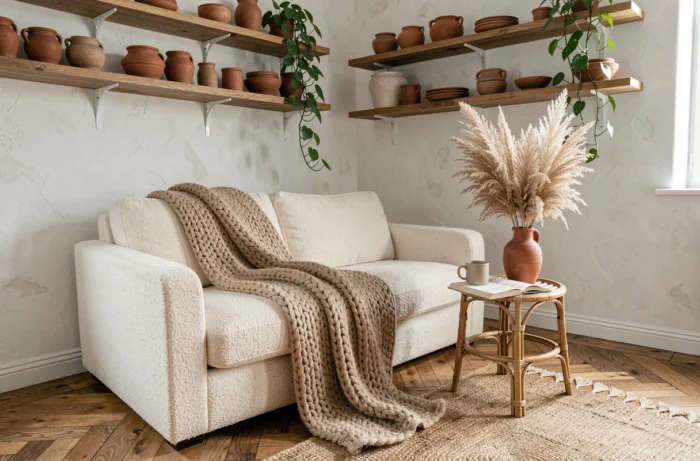
Terracotta, sage green, and ecru shades dominate current cocooning palettes. Combined with indirect lighting (floor lamps directed towards the ceiling, warm white LED garlands), they create a soothing visual envelope. Indirect light softens volumes better than a central ceiling fixture.
Bedroom and sleeping area
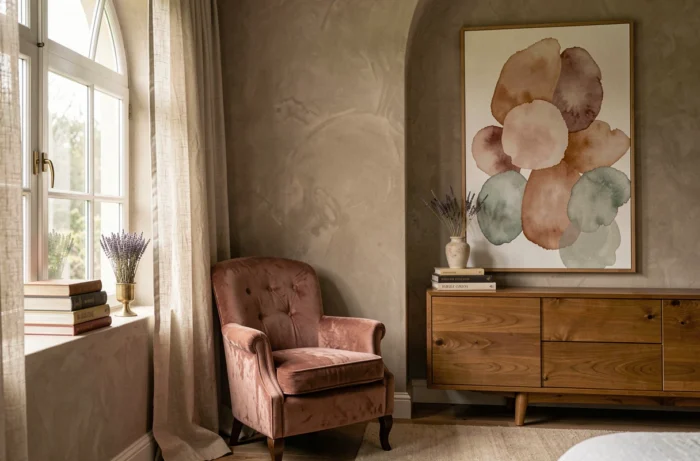
The cocooning bedroom relies on layering textile elements: a linen sheet, a thick duvet, a knitted bed throw. Colors become more muted (stone gray, off-white, deep navy blue). Lighting is limited to adjustable bedside lamps, placed low to avoid any light source at eye level when lying down.
Office or reading nook
A cozy chair, a blanket within reach, an adjustable reading lamp: cocooning in a workspace relies on three elements, no more. Too many decor accessories in a small space creates visual clutter, the opposite of a refuge.
Transforming your interior into a warm cocoon is less about the quantity of objects added than about the coherence between light, sound, materials, and proportions. The most successful spaces are often those where an element has been removed rather than added.