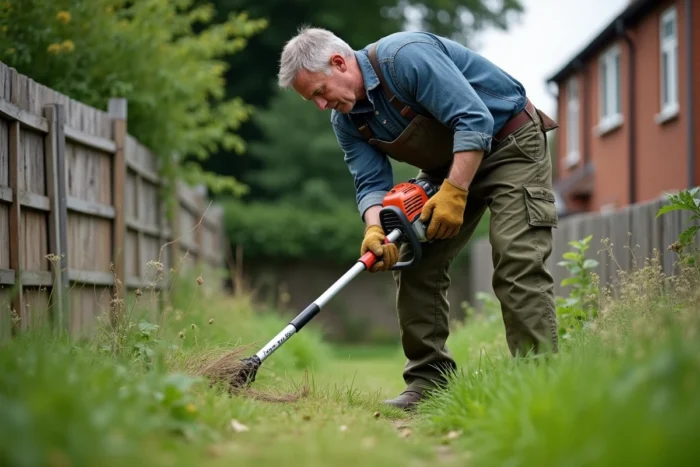
A plot left unattended for a few weeks is enough for tall grasses, brambles, and shrub regrowth to take over. The mower can no longer pass, and the string trimmer struggles. This is precisely where the brush cutter comes in, a tool designed to handle dense vegetation in rugged or hard-to-reach areas.
Choosing the right brush cutter involves considering several parameters: the nature of what you are cutting, the frequency of use, and the configuration of your terrain. Here are some concrete guidelines to make an appropriate choice without overpaying.
Vegetation and frequency of intervention: the real starting point
Most guides start by listing the types of machines. The problem is that this classification is useless until you have identified what you will actually be cutting and how often.
Do you maintain lawn edges and some wild grasses along a wall once a week? A lightweight string trimmer is sufficient. Are you letting a slope grow for several months before intervening? You will need a device capable of cutting through thick stems and woody brambles.
The nature of the vegetation determines the type of machine, not the other way around. Fine grasses and reeds can be cut with nylon line. Brambles, young tree shoots, and underbrush require a toothed blade or a metal disc. In a situation where both scenarios coexist, a versatile brush cutter with an interchangeable head remains the best compromise.
A well-organized catalog helps visualize these correspondences between vegetation and cutting tool. The sheets available on debroussailleuse-warrior.com classify models by use, simplifying comparison.
Another often-overlooked parameter: the frequency of intervention changes the game regarding the required power. Regular maintenance (every two to three weeks) keeps the vegetation low and allows for work with a modest engine. Seasonal clearing on an overgrown terrain requires significantly more torque and endurance.

Gas or battery brush cutter: moving beyond the classic debate
The choice between gas-powered and battery-operated does not boil down to “power versus practicality” anymore. Brushless motors on batteries have advanced to the point of handling fairly dense vegetation during reasonable work sessions.
When gas remains relevant
On large areas (beyond a few hundred square meters of underbrush), the gas engine offers unlimited autonomy as long as the tank is full. It delivers constant torque even on thick brambles. Brands like Stihl, Husqvarna, or Echo offer proven ranges in this segment.
Gas is suitable for long interventions on dense vegetation. However, it requires regular maintenance: spark plug, air filter, oil-gas mixture for two-stroke engines.
When battery takes the advantage
For a medium-sized garden maintained regularly, a battery brush cutter covers most needs. The start is instant, the noise level is much lower, and the absence of exhaust fumes makes the work less burdensome.
A recent buying criterion deserves your attention: interchangeable battery platforms. Several manufacturers now offer a single range of batteries compatible with the chainsaw, hedge trimmer, blower, and brush cutter. Investing in a unique ecosystem reduces overall costs and the number of chargers cluttering the garage.
Weight, ergonomics, and harness: what changes everything on the ground
Have you ever held a brush cutter for more than twenty minutes? The weight of the machine quickly becomes noticeable in the arms and back. This is a criterion that many guides mention without really explaining.
Weight alone does not tell the whole story. What matters is the distribution of the load and the quality of the harness. A machine weighing several kilograms equipped with an adjustable padded shoulder harness tires less than a lighter model held at arm’s length with a simple strap.
- A U-shaped handle (known as a “bike handle”) offers good stability for sweeping movements on flat or gently sloping terrain.
- A D-handle is better suited for cluttered areas, between trees or in flower beds, where maneuverability is key.
- A backpack harness (back brush cutter) distributes the weight over the shoulders and hips, essential for prolonged sessions on rugged terrain.
Before purchasing, check that the tube is telescopic or that its length matches your height. Working bent forward for an hour can cause lasting lower back pain.
Cutting head and blade: adapting the cutting tool to each situation
The cutting head is the part that does the work. Choosing the wrong one is like using a butter knife to cut wood.
Nylon line is suitable for fine grasses and edge finishing. It comes in round section (versatile), square (cleaner cut on dry grasses), or star-shaped (better grip on slightly tougher stems). The diameter of the line must match the power of the motor: a line that is too thick on a weak motor will jam the machine.
For brambles and woody underbrush, you need to switch to a blade. Several options exist:
- Three-tooth blade: versatile, suitable for dense grasses and young shoots.
- Eight-tooth blade or more: designed for thick brambles and small shrubs.
- Brush disc: cuts stems several centimeters in diameter, reserved for powerful brush cutters with a harness.
Some models accept both systems (line and blade) thanks to an interchangeable head. This versatility avoids the need to buy two separate machines.
Clearing and fire prevention: a requirement to integrate
The choice of a brush cutter is not solely based on aesthetic needs. In areas classified as fire risk (near forests, scrubland, garrigue), clearing is a legal obligation for property owners. Regulations require maintaining a cleared perimeter around homes.
This constraint directly influences the type of machine needed. A plot bordering a forest quickly accumulates dense regrowth of kermes oak, broom, or rockrose. A simple string trimmer will not suffice. You need a device capable of mowing semi-woody stems over sometimes large areas, with an appropriate blade system.
Check with your town hall if your plot is subject to a clearing obligation. The type of vegetation to be treated and the area to be maintained will guide your purchase towards a specific power category.
The right reflex is to start from the terrain, not the catalog. Identify what is growing, measure the area to be treated, evaluate the realistic frequency of maintenance. The rest, engine power, cutting type, and motorization, logically follows from that.