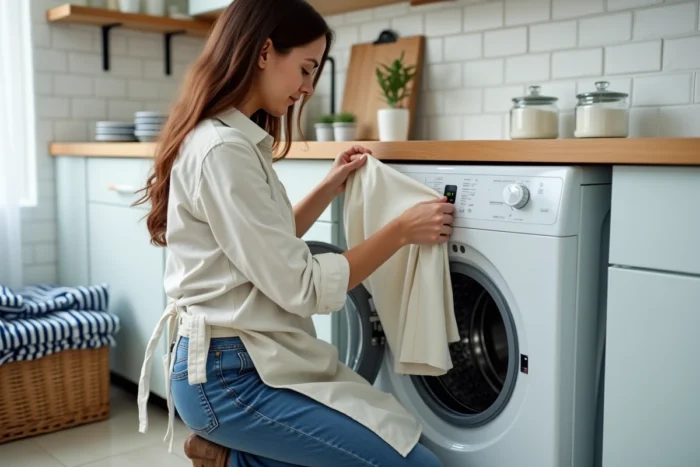
A batch of aprons coming out of the machine in a compact ball, cords tied together and fabric wrinkled to the point of needing to restart a cycle: we all know this scenario. The problem does not come from the apron itself, but from how the ties and fabric panels interact with the rest of the laundry during the spin cycle. A few preparation steps before washing can radically change the outcome.
Apron cords in the machine: the mechanics of tangling
We underestimate how much the cords are the main cause of the knot. During the cycle, the drum spins at several hundred revolutions per minute during the spin. The ties, loose and light, wrap around other pieces of laundry, then tighten under centrifugal force.
The phenomenon worsens when washing several aprons together. The cords of one pass through the eyelets or pockets of another, creating a tangle that can sometimes be difficult to undo without damaging the fabric.
The most reliable solution: tie the cords together before putting the apron in the machine. Tie the neck straps together, then those at the waist, with a simple knot (not a double knot, otherwise it’s a hassle to undo). This single habit eliminates the majority of tangles. To delve deeper into this point, you can find MYN Idee’s tips that detail several variations of this technique.
Washing net and folding: the method for thick cotton aprons
When working with thick cotton bib aprons, the weight of the wet fabric pulls on the seams if the apron twists into a ball. The washing net solves the problem, provided it is used correctly.
Fold before bagging
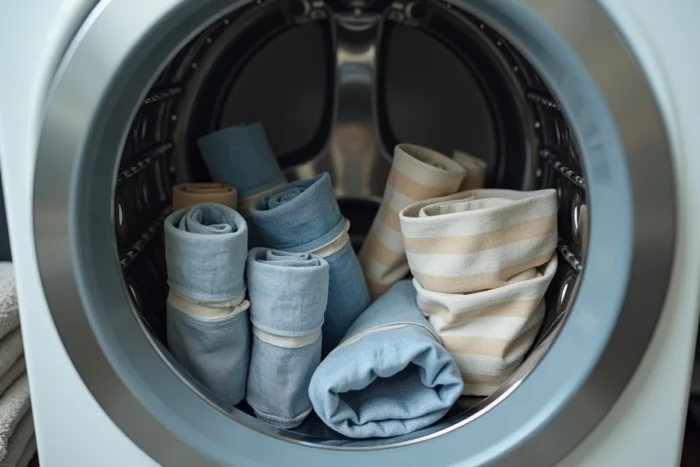
Fold the apron into thirds lengthwise, with the cords tucked in front. Slide everything into a zippered net large enough so that the fabric is not compressed. A net that is too small prevents water and detergent from circulating, leaving poorly washed areas.
One net per apron works better than two aprons in the same bag. Experiences vary on this point when it comes to thin polyester aprons, but for cotton, it’s clear: one net, one apron.
Amount of laundry in the drum
Filling the drum to a maximum of two-thirds leaves enough space for the laundry to circulate freely. A stuffed drum forces textiles to wrap around each other, net or not.
- Thick cotton aprons: wash them with similarly weighted laundry (kitchen towels, napkins), never with lightweight clothing whose sleeves get tangled in the cords.
- Polyester or polycotton aprons: they can handle a shorter cycle and dry quickly, and can be grouped together without a net if the cords are well tied.
- Linen aprons: delicate cycle, reduced spin, net strongly recommended to limit wrinkling as well as tangling.
Adjusting the wash cycle to avoid knots
The choice of program has a direct impact. A maximum spin speed is the primary factor for tangling after the loose cords. Reducing the spin speed by one notch (from maximum speed to an intermediate speed) decreases the centrifugal force that tightens the knots.
The standard cotton cycle, often set at high temperature, is suitable for greasy kitchen aprons. For service or barista aprons with light stains, a synthetic program at moderate temperature is sufficient and agitates the laundry more gently.
Stain pre-treatment before machine washing
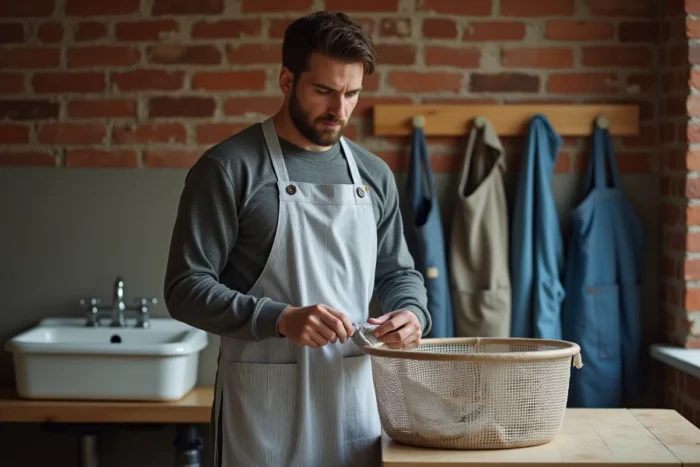
We tend to compensate for stubborn stains by increasing the temperature or duration of the cycle, which worsens tangling. A more effective approach: treat the stain before machine washing.
- Grease stains: rub with slightly damp Marseille soap, let sit for about thirty minutes, then start the normal cycle.
- Tomato sauce or wine stains: blot with a mixture of cold water and baking soda before washing. Hot water sets the pigments, so always rinse with cold first.
- Old ingrained stains: soak the apron in a basin of warm water with a dose of sodium percarbonate for an hour before putting it in the machine.
By treating stains beforehand, you can then wash at a lower temperature, with moderate spin, and get a clean apron without turning it into a Gordian knot.
Professional aprons in restaurants: HACCP constraints and maintenance
In professional kitchens, washing aprons is not just a matter of comfort. HACCP protocols impose a cleaning-disinfection plan that also covers textiles in contact with the food environment. The products used for pre-treatment or rinsing must be approved for indirect food contact, in accordance with EN 1276 (bactericidal activity) and EN 13697 (non-porous surfaces) standards.
Classic household detergent is not sufficient in a professional context. Collective kitchens use professional detergents formulated to meet these requirements, often at higher washing temperatures. The paradox: the higher the temperature, the greater the risk of tangling.
The solution observed in restaurants is to combine individual washing nets and a professional high-temperature cycle. Some establishments use industrial front-loading machines with a wider drum, which mechanically reduces the problem. For those washing their aprons at home, adhering to the trio of tied cords, net, and moderate spin remains the foundation.
The European regulation 2026/405 on detergents and surfactants, published in March 2026, will gradually change the composition of detergents available on the market, with full implementation expected by 2029. Formulations will evolve towards more biodegradable surfactants, which could change dosage recommendations for professional textiles.
Keeping your aprons in good condition after each cycle does not require expensive equipment. Tying the cords, using an appropriate net, and lowering the spin speed by one notch form a trio of simple actions that solve the problem in the vast majority of cases. The rest is a matter of common sense regarding drum filling and stain pre-treatment.