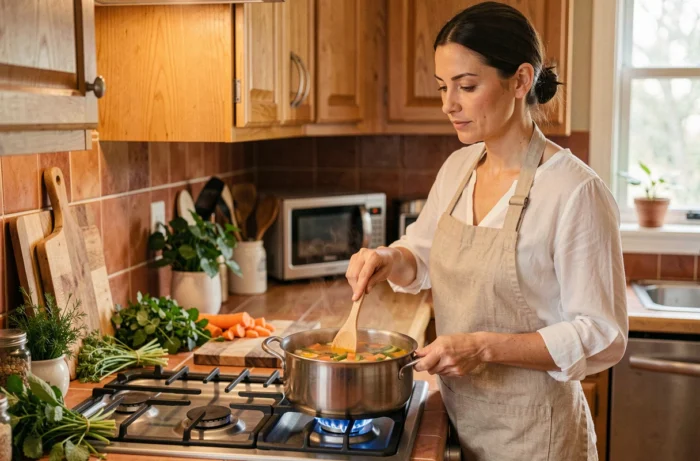
The ongoing decrease in the time dedicated to dinner preparation prompts a rethinking of everyday savory recipes from a technical perspective. We observe that the recipes that truly work day-to-day share a common trait: they rely on mastered cooking methods rather than an accumulation of ingredients. Building a repertoire of reliable dishes requires understanding a few specific mechanisms.
Low-temperature cooking in everyday life: the underutilized lever
Low-temperature cooking is not reserved for gourmet restaurants. When applied to economical cuts (shoulder, chuck, lamb shank), it transforms an ordinary meal into a dish with impeccable texture, without active monitoring.
The principle is simple: maintain an oven temperature between 80 and 120 °C for several hours. Collagen converts to gelatin, the meat remains juicy, and the margin for error almost entirely disappears. Low-temperature cooking easily tolerates thirty minutes of delay, making it ideal for an unpredictable schedule.
We recommend searing the piece in a pan before placing it in the oven to trigger the Maillard reactions. A cast-iron pot with a lid is sufficient. Root vegetables (carrots, parsnips, potatoes) added halfway through cooking absorb the juices and complete the dish without extra effort. To explore other approaches of this kind and find suitable recipe ideas, you can visit the L’Entracte Gourmand website, which details several preparations oriented towards this style.
Air fryer and everyday recipes: beyond frying
The air fryer is present in nearly 38% of French households in 2025, according to data from Gifam relayed by Offrir International. After a 129% increase in 2024, the device has firmly established itself in kitchens.
Uses far exceed classic frying. A large majority of users employ their air fryer for roasted vegetables, gratins, cakes, and even saucy dishes. This marks a paradigm shift for quick home cooking.
Three preparations that take advantage of forced convection
- Side vegetables (zucchini, peppers, mushrooms) roasted in less than fifteen minutes, with caramelization that is impossible to achieve as quickly in a traditional oven
- Thin tarts on store-bought puff pastry, baked at high temperature for a clean flakiness without long preheating
- Individual gratins in compatible ramekins, where the cheese crust forms in just a few minutes thanks to direct air flow
The technical point to remember: forced convection dries the surface of foods much faster than a conventional oven. For recipes that require a moist interior (cake, bread), a light brushing of oil or a covered resting time after cooking corrects this tendency to dryness.
Homemade sauce in five minutes: the express stock technique
A sauce transforms a bland dish into a savory recipe. The problem: most sauce recipes require a veal or poultry stock that no everyday cook prepares on a Tuesday evening.
Deglazing the cooking pan advantageously replaces a classic stock. After searing meat or fish, deglaze the pan with an acidic liquid (white wine, cider vinegar, lemon juice). Scrape the browned bits, add a spoonful of mustard or cream, and reduce for a minute. The result has an aromatic complexity disproportionate to the effort involved.
Some tried-and-true combinations:
- Pan-fried chicken, deglazed with white wine, cream, and fresh tarragon
- Pork tenderloin, deglazed with cider vinegar, honey, and whole grain mustard
- Salmon steak, deglazed with lemon juice, brown butter, and capers
Each combination takes less than five minutes after the main cooking and requires no exotic ingredients. The technique works equally well for a solo meal as for entertaining.
Homemade pie crust without a mixer: quick crumb method
Buying ready-to-roll puff pastry is justified by the complexity of rolling. For a shortcrust or crumb crust, the calculation is different. A homemade crumb crust can be prepared in less than ten minutes without a mixer.
The method relies on finger crumbling: flour, cold butter cut into small cubes, salt, a bit of sugar if the recipe is sweet. Crumble between your fingers until you achieve a coarse sand texture. Add an egg yolk and a spoon of cold water, gather without kneading. The dough rests for thirty minutes in the refrigerator while you prepare the filling.
This dough is suitable for savory tarts (tomato-mustard, leek-cheese, potato-bacon) as well as seasonal fruit tarts. The technical advantage over industrial versions: the butter/flour ratio is adjustable according to the desired result, more crumbly for a dessert, firmer for a quiche.
Meal planning without rigid batch cooking
Batch cooking requires dedicating several hours on Sunday to prepare the entire week. For many households, this scheme does not hold beyond a few weeks.
A more realistic approach is to prepare versatile bases alongside an already ongoing meal. While one dish is cooking in the oven, start cooking grains (rice, quinoa, bulgur) and roast a batch of vegetables. These elements can be stored for several days and serve as the foundation for different recipes each evening: composed salad, grain bowl, side for pan-seared protein.
The idea is not to plan everything, but to have ready components that reduce friction at mealtime. Two pre-cooked bases are enough to cover three dinners without repetition, provided you vary the seasonings and sauces.
The average time spent in the kitchen each evening has continued to decrease since the late 1990s. The savory recipes that survive day-to-day are those that rely on solid technique and a few well-chosen ingredients, not those that multiply spectacular steps. Mastering deglazing, crumbling dough by hand, utilizing a convection cooking device: these simple skills build a sustainable culinary repertoire.